.svg)



Customer Experience
Customer intent: What it is, why businesses misread it, and how to fix that
Learn what customer intent means, how to spot intent signals across channels, and how CX teams can turn those insights into faster, more relevant action.
Learn what customer intent means, how to spot intent signals across channels, and how CX teams can turn those insights into faster, more relevant action.


Most businesses respond to what customers do. The smarter ones respond to why they did it.
That difference is where better decisions, faster service, and more relevant personalization begin.
Customer intent is the goal, purpose, or problem behind a customer’s interaction with a brand. It explains what the customer is trying to accomplish, not just what they clicked, searched, said, or purchased.
When businesses misread customer intent, personalization becomes generic, support becomes slower, and customer journeys start to feel disconnected from what people actually need.
Customer intent is the reason behind an action: It explains what a customer wants to accomplish, not just what they clicked, said, or searched.
Intent changes with context: A customer’s goal can shift based on timing, urgency, channel, and previous interactions.
There are six common types of intent: Informational, transactional, navigational, support, comparative, and re-engagement.
Intent signals appear everywhere: Support tickets, social conversations, surveys, call transcripts, website behavior, CRM history, and even silence can reveal intent.
Action matters most: Customer intent is only valuable when teams use it to improve routing, personalization, resolution quality, and retention.
Customer intent is the reason a customer interacts with your business. It is what they want to accomplish, the problem they hope you will solve, or the next step they are trying to take.
Most businesses claim to put customers first, but many processes are still built around internal goals rather than customer needs. Teams track clicks, tickets, and conversions, but they do not always ask why those actions happened.
That is where misreading begins.
A customer who visits a pricing page may be ready to buy. They may also be comparing options, looking for hidden fees, or trying to justify staying with the current provider. The action is the same. The intent is different.
Businesses consistently misread customer intent for three reasons. First, they track actions without understanding motivation. Second, they rely too heavily on assumptions or third-party research instead of direct customer signals. Third, they keep intent data siloed across marketing, sales, service, and CX teams.
Customer intent is often confused with behavior, preference, and purchase intent, but each concept answers a different question.
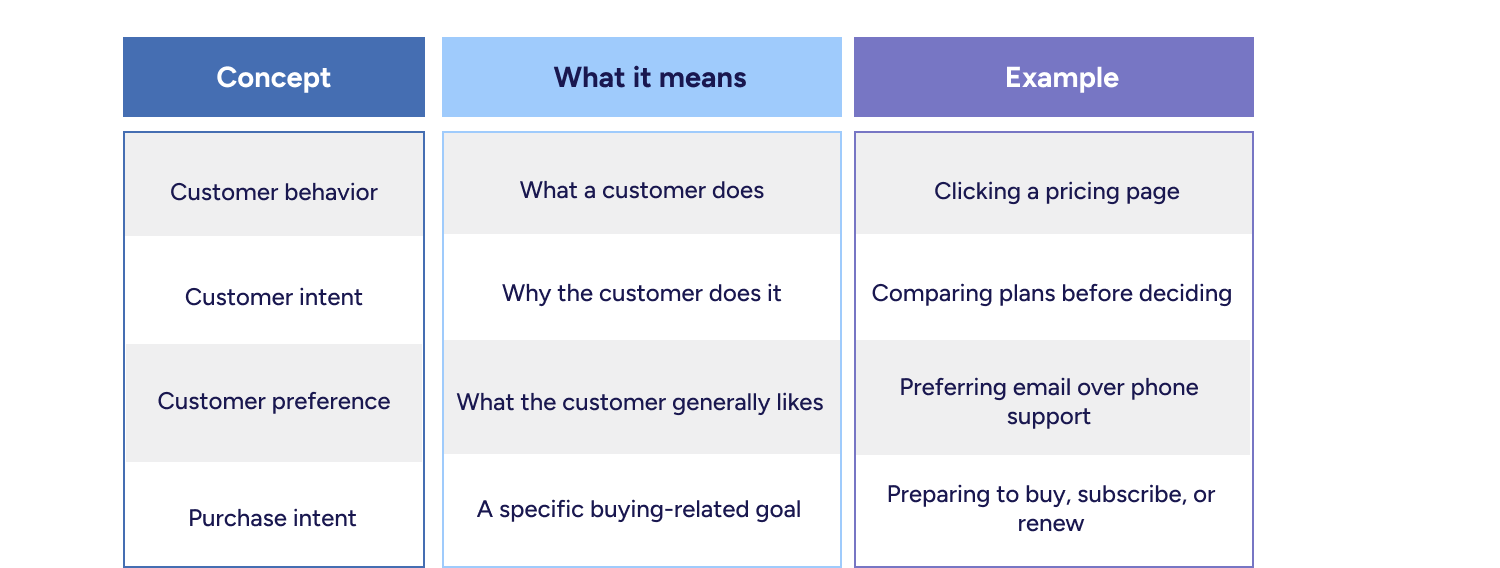
Customer behavior shows what happened. Customer intent explains why it happened.
That distinction matters because the same behavior can reflect different goals. A customer who searches for “cancel subscription” may want to leave, compare plans, pause temporarily, or solve a billing issue. Without context, teams may respond to the action and miss the real need.
The six main types of customer intent are informational, transactional, navigational, support, comparative, and re-engagement. Each type signals a different need and requires a different response.
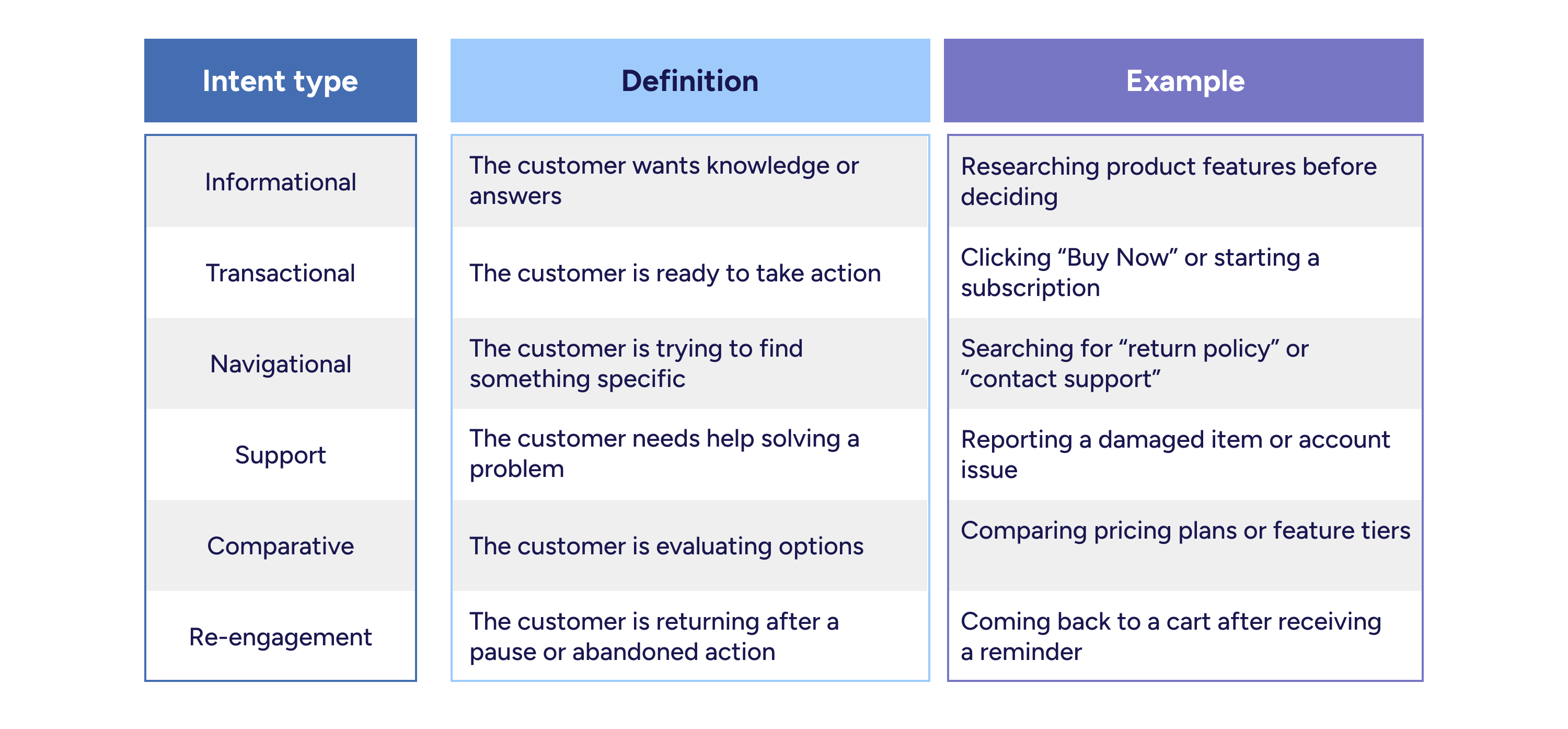
Understanding the type of intent helps teams decide what should happen next.
A customer with informational intent may need helpful content. A customer with support intent needs resolution. A customer with comparative intent may need proof, reassurance, or a tailored recommendation. Treating all three the same creates friction.
Customer intent signals appear across every channel where customers interact with your brand. The most reliable sources are support conversations, service tickets, customer surveys, social media comments, public complaints, website search queries, live chat, email, call transcripts, CRM history, and purchase behavior.
Intent signals often show up in places teams do not always treat as strategic.
A customer who contacts support at 2 AM is probably not casually browsing. The timing itself may suggest urgency, especially when paired with previous tickets, failed actions, or repeated searches.
A customer who moves from a public complaint to a private message is not merely changing channels. They are changing strategy. That shift may signal escalation, embarrassment, urgency, or a desire for a more direct resolution.
The difference between “I was wondering if you could help” and “I need this fixed now” reveals expectation, urgency, and emotion. These signals appear in chat logs, emails, call transcripts, survey responses, and agent notes.
Sometimes the strongest signal is no signal at all. A customer who goes quiet after a poor resolution may not be satisfied. They may have stopped expecting improvement.
That is why customer intent analysis should combine spoken feedback, behavioral data, and engagement patterns instead of relying on one source.
Stated intent is what customers tell you directly. Behavioral intent is what their actions imply.
Stated intent: “I want to cancel my subscription.”
Behavioral intent: Visiting the cancellation page three times without submitting the form.
The most accurate view of customer intent combines both. What customers say and what customers do do not always tell the same story.
At scale, AI and conversation analytics can surface intent signals across text, voice, and behavioral data, helping teams detect patterns that would otherwise stay scattered across channels.
AI-powered intent detection works by analyzing what customers say, how they say it, and what their actions imply in real time.
Natural language processing helps classify the purpose behind a message. Is this a complaint, a question, a purchase signal, a cancellation risk, or a request for help? Sentiment and tone analysis add the emotional layer. Machine learning models improve over time by learning which phrases, behaviors, and conversation patterns correlate with specific outcomes.
This is where customer service AI becomes useful beyond automation. It helps teams understand the customer’s goal before they respond, route, or escalate.
AI intent detection can support:
But AI is only useful when the data beneath it is connected. If support, marketing, sales, and CX each hold different versions of the customer, intent detection becomes incomplete.
When customer intent is misread, personalization fails at the moment it matters most.
A customer with support intent who receives a promotional offer does not feel understood. They feel ignored.
A customer with comparative intent who is pushed to complete a purchase before they are ready may not convert. They may leave.
A customer who shows dissatisfaction through silence and receives a generic satisfaction survey in response does not feel heard. They may churn quietly.
Misread intent can increase average handle time, reduce first contact resolution, weaken customer satisfaction, and create preventable churn risk. Personalization built on assumed intent is not personalization. It is a guess dressed in the language of relevance.
This is also why customer feedback should not stay trapped in dashboards. Intent only becomes useful when it changes what teams do next.
Businesses often misread customer intent when they treat every signal equally, rely on outdated or third-party data, isolate insights inside one team, or collect data without building workflows to act on it.
Forrester has also warned that teams often misuse intent data when they treat sources equally, undervalue first-party intent, or fail to understand how intent signals are collected and interpreted. You can see this reflected in Forrester’s discussion of common intent data mistakes.
Many businesses log clicks, messages, and calls as if they all carry the same meaning. That misses the actual reason someone reached out.
Fix: Look at the full context: customer profile, history, previous cases, journey stage, and what happened before the latest action.
Market research can be useful, but it should not replace what customers tell you directly through conversations, feedback, support interactions, and behavior on owned channels.
Fix: Prioritize first-party data from chats, emails, calls, surveys, CRM records, and product usage. First-party data is often closer to what customers actually need right now.
For a deeper look at how owned customer data supports smarter engagement, read The power of zero- and first-party data.
Customer intent changes quickly. A customer who was researching yesterday may need urgent support today.
Fix: Treat recency as a decision rule. The freshest signals usually deserve the most attention, especially when a customer moves from browsing to urgency within the same journey.
Marketing, sales, support, and CX teams often hold separate versions of the customer. That creates disconnected experiences.
Fix: Share customer intent insights across teams and connect them to common workflows. If support sees one story and marketing sees another, the customer ends up doing the reconciliation.
Frequency does not prove relevance. It may only prove that the scheduling tool is working.
Fix: Send fewer, better-timed messages based on what the customer is trying to accomplish now. Relevance beats repetition.
Relying only on tickets, website visits, or CRM fields creates blind spots.
Fix: Combine touchpoints across web, service, feedback, purchase history, and public conversations. Customers move between channels freely, so your analysis has to keep up.
Taking every signal at face value can send teams toward the wrong issue, especially when data quality is poor or phrasing is unclear.
Fix: Validate signals against multiple sources and test classifications regularly. The goal is not to collect more noise with greater confidence. It is to interpret signals with enough context to act well.
Many businesses measure success by how much customer intent data they collect rather than by what they do with it.
Fix: Build workflows that turn insight into action immediately. If nothing changes after detection, the analysis may be interesting, but it is not useful enough.
A strong customer intent analysis process helps teams move from signal detection to better action. The process should be simple, repeatable, and connected to business outcomes.
Start with what customers tell you directly and what they reveal through owned interactions: support conversations, survey responses, live chat, email, search queries, product usage, CRM data, and purchase behavior.
Define the intent categories that matter for your business. The six standard types are a strong starting point, but your taxonomy may also include industry-specific intent signals such as renewal risk, onboarding need, service recovery, or upgrade readiness.
A customer who complains publicly, moves to a private message, and later calls support is expressing the same need across multiple touchpoints. Your systems should treat that as one journey, not three disconnected interactions.
Use AI and natural language processing to classify incoming messages, tickets, and interactions by intent type as they arrive.
Route support-intent contacts to the right team immediately. Flag comparative-intent customers for personalized follow-up. Prioritize urgent cases based on timing, language, sentiment, and customer value.
Track whether intent-based routing improves first contact resolution, whether personalized responses improve conversion, and whether proactive outreach reduces churn risk.
The goal is not to label customers. The goal is to respond better.
Personalization without understanding intent is guesswork.
Lucidya helps teams detect customer intent across conversations, feedback, social signals, and customer history, then turn that insight into better action across the customer journey.
The first problem is fragmentation. Intent signals are scattered across public posts, private messages, support threads, survey responses, and purchase history. OmniServe centralizes conversations into a single workspace, so teams see the full context of each interaction.
Social Listening captures public customer signals before they become service failures, while Survey turns direct customer feedback into structured insight.
The second problem is organizational blindness. Intent data often stays trapped in one team. Profiles connects behavioral, sentiment, and conversation data into unified customer profiles, so marketing, support, sales, and CX leaders work from the same customer picture.
The third problem is action. Detecting intent does not matter if nothing changes afterward. AI Agent helps teams move from detection to resolution by supporting routing, prioritization, and automated workflows for routine customer needs.
That is how customer intent stops being a theory and becomes operational practice.
Customer intent is the goal, purpose, or problem behind a customer interaction. It explains what the customer is trying to accomplish in a specific moment, whether that is finding information, resolving an issue, comparing options, or making a purchase.
Purchase intent is one specific type of transactional customer intent. Customer intent is broader. It covers every goal a customer might have across the full journey, from learning and comparing to requesting support or re-engaging after a gap.
The main types are informational, transactional, navigational, support, comparative, and re-engagement. Each type reflects a different customer need and should trigger a different response.
Businesses identify customer intent by analyzing support tickets, chat logs, call transcripts, social mentions, survey responses, website behavior, CRM history, and purchase patterns. These signals must be interpreted in context because behavior alone shows what happened, not always why.
AI uses natural language processing, intent classification, sentiment analysis, and historical interaction data to identify what a customer is trying to achieve in real time. This helps teams route, prioritize, personalize, and resolve interactions more effectively.
Customer intent helps teams respond faster, personalize more accurately, route requests to the right place, and reduce customer effort. When teams understand the purpose behind an interaction, they are better positioned to improve resolution quality, satisfaction, and retention.
Yes. A customer may start with informational intent, shift into comparison, and then move into support or transaction within the same conversation. That is why real-time detection matters more than static labels.


Lucidya is an AI-native customer experience management (CXM) platform that connects social listening, media monitoring, omnichannel customer service, a customer data platform, survey tools, and autonomous AI resolution into one system. The platform is built on proprietary NLP that processes Arabic natively across 17+ dialects with 92% sentiment accuracy, rather than relying on translation layers that lose nuance and context. Most enterprise CX teams run five or six separate tools to cover these functions, Lucidya replaces that stack with a single connected platform where every product shares the same data layer. The result: when your AI Agent resolves a customer case, it already knows that customer's sentiment history, social behavior, and full interaction record. When your PR team spots a brand mention in the news, that signal connects to the same platform handling customer service. Intelligence and action happen in one place.
Lucidya covers the full range of channels where customer conversations happen: social media (X, Instagram, Facebook, YouTube, TikTok, Snapchat), news and media (1,600+ online news sites, blogs, forums, print, TV, and radio), public reviews across 20+ platforms including Google Maps, Airbnb, TripAdvisor, Booking.com, Glassdoor, and G2, as well as WhatsApp, email, social DMs, live chat, voice and call center data, and survey and website feedback. Every channel feeds the same platform. So when something moves from social into news coverage, or from a WhatsApp complaint into a broader service pattern, your team sees it in one place rather than catching it late in a second tool.
Lucidya is six integrated products on one AI engine, deployable together or individually. Social Listening monitors brand mentions, competitor activity, and emerging trends across social channels in real time. Media Monitoring tracks brand presence across 1,600+ news, blog, forum, print, TV, and radio sources — the coverage that social-only tools miss. OmniServe is an omnichannel inbox that unifies messages from social media, WhatsApp, email, and live chat into one AI-powered workspace with sentiment-aware routing and full customer context for every agent. Profiles is a Customer Data Platform that builds 360-degree customer views by connecting behavioral, sentiment, interaction, and demographic data across all touchpoints. It combines customer identities and interactions from multiple channels into one centralized profile, so teams can see the full history of how a customer has engaged across social, support, surveys, and every other channel in one place. Survey collects and analyzes customer feedback across channels with AI-native sentiment analysis on open-text responses. AI Agent resolves customer cases end to end autonomously across WhatsApp, social media, and other channels, executing actions, completing workflows, and closing cases without human intervention. Role-based access controls, PII masking, audit trails, and a kill switch are built in for regulated industries.
Most enterprise CX platforms are built around one primary function, ticketing, social listening, or marketing, and require additional tools for everything else. Lucidya is built as a unified system from the ground up. Unified data layer. Every product shares the same underlying data. The AI Agent has access to social listening data. The omnichannel inbox connects to the CDP. Media monitoring feeds the same dashboard as social. This eliminates the data silos that make enterprise CX slow and reactive. Proactive by design. Lucidya's intelligence layer monitors brand mentions, tracks sentiment shifts, and surfaces competitor activity before customers contact you. Most platforms start at the ticket. Lucidya starts earlier. Modular adoption. Unlike platforms that require full migration to access AI capabilities, Lucidya's products can be adopted individually. Start with social listening, add the AI Agent later, without rebuilding your stack. Multilingual accuracy. Lucidya's AI engine achieves 92% sentiment accuracy in both English and Arabic, with native training across 17 Arabic dialects. For global brands operating in Arabic-speaking markets, this is the difference between accurate intelligence and confident noise.
Lucidya serves enterprise brands, government entities, and large organizations that need accurate, real-time customer intelligence at scale. Key sectors include banking and financial services, telecommunications, travel and tourism, insurance, hospitality, healthcare, and logistics. It is used by organizations that need proactive brand intelligence, not just reactive ticketing, and by regulated industries that require compliance-grade governance controls over their AI systems. For global enterprises operating in or expanding into Arabic-speaking markets, Lucidya provides the only CXM platform with native Arabic-language AI across 17 dialects.
Lucidya complies with GDPR, CCPA/CPRA, Saudi PDPL, SOC 2 Type II, ISO/IEC 27001, ISO 27017, HIPAA Ready, NIST CSF, and Tier 2 CASA Verified standards, with regional data hosting available in Saudi Arabia and the GCC. This covers the core compliance requirements for enterprise deployments in the UK, US, EU, and Gulf markets. For organizations operating in Saudi Arabia and the GCC, Lucidya additionally holds SDAIA and NCA ECC/CCC certifications with regional data hosting options. All AI Agent actions are governed by a policy engine, logged in a full audit trail, and can be paused instantly. Role-based access controls and PII masking are built into the core platform.
Lucidya achieves 92% sentiment accuracy in both English and Arabic. For English-language markets, this means reliable sentiment detection across social, news, and customer service interactions without the false positives that degrade signal quality at scale. For Arabic-language markets, accuracy at this level requires native training rather than translation. Lucidya's NLP engine is trained on 17 Arabic dialects, covering Gulf Arabic (Khaleeji Arabic), Egyptian, Levantine, Maghrebi, and other regional variants, because sentiment in Arabic varies significantly across dialects. Tools that translate Arabic to English before analysis lose this nuance before any processing occurs. For global brands with operations in MENA, this is the accuracy gap that makes or breaks customer intelligence in the region.
Global brands face a specific version of the fragmented CX problem, they need tools that work across markets, languages, and regulatory environments without requiring a different vendor for each region. Lucidya addresses this in three ways. One platform across channels. Social, news, messaging, live chat, surveys, and AI resolution in one system, regardless of which market you're operating in. Compliance built in. GDPR, CCPA, SOC 2, ISO 27001, and regional certifications for Gulf markets, covered in one platform rather than requiring separate compliance configurations per region. Multilingual AI that actually works. 92% sentiment accuracy in English and Arabic, with native dialect training rather than translation. For brands expanding into the Middle East, or already operating there, this is the capability that global-first platforms cannot replicate from a standing start.

.svg)


.svg)