Customer churn prediction: How CX teams can reduce churn
Customer churn rarely happens overnight. Learn how CX teams can use churn prediction to detect early risk signals, connect customer data, and act before valuable customers leave.
February 18, 2025
|
13
min read
|
Author:
Nour Manasseh
Customer churn prediction helps CX teams identify which customers are likely to leave by analyzing behavioral, support, feedback, sentiment, and account data. Instead of waiting for cancellations or declining revenue, teams can use churn risk signals to intervene earlier with proactive support, better onboarding, retention workflows, and personalized outreach.
Every good customer experience strategist knows that what you see on the surface, rising sales, metrics ticking upward, and glowing reviews, rarely tells the whole story.
What matters often happens in the background: the quiet frustrations, unresolved tickets, fading engagement, and subtle signals that keep customers loyal or send them walking away.
That is exactly where customer churn prediction comes in. Instead of waiting for cancellation data, it helps CX teams detect churn risk from the signals customers leave behind long before they officially leave.
Customer trust is not built on grand gestures or flashy campaigns. It is earned in everyday interactions: follow-ups, transparency, resolution quality, and constant listening. Fail to nurture those, and by the time trouble appears in your metrics, the damage may already be done.
Key takeaways
Churn is rarely sudden: Customer churn is usually the result of subtle frustrations that build over time.
Surveys are not enough: Traditional surveys capture conscious feedback, but they often miss deeper patterns in behavior, sentiment, and engagement.
Prediction must lead to action: The goal is not only to identify churn risk, but to trigger the right retention workflow before the relationship breaks.
Unified data matters: Churn signals become more useful when support history, survey feedback, social sentiment, product usage, and account data are connected.
AI strengthens CX intelligence: AI-powered CX tools help teams detect patterns earlier, prioritize risk, and act with more context.
What is customer churn prediction?
Customer churn prediction is the process of using historical and real-time customer data to estimate which customers are likely to cancel, disengage, or stop purchasing before they actually do.
It works by analyzing behavioral patterns, sentiment signals, support history, account data, and engagement trends to assign a churn risk score to each customer. The goal is to give CX, support, success, and retention teams enough advance warning to intervene before a relationship ends.
In business terms, customer churn prediction turns scattered signals into a practical early-warning system. A churn prediction model does not need to be a complicated data science project to be useful. It simply needs to combine the right inputs: behavior, feedback, support activity, sentiment, and commercial data, then produce a clear output: which customers look safe, which look at risk, and which need immediate attention.
Churn rate vs. churn prediction
Customer churn rate is calculated by dividing the number of customers lost during a period by the number of customers at the start of that period, then multiplying by 100.
Customer churn rate = (customers lost during a period ÷ customers at the start of the period) × 100
For example, if you started a month with 1,000 customers and lost 30, your monthly churn rate is 3%.
Churn rate tells you what already happened. Churn prediction tells you what is likely to happen next.
Customer churn rate is useful for reporting, but it cannot tell your team which relationships are weakening right now. Customer churn prediction fills that gap by reading present-day patterns before they show up in revenue loss.
Why traditional feedback tools miss the warning signs
When a relationship with your customer ends, you might blame the final thing that went wrong: a negative experience, a missed opportunity, or a competitor’s offer.
But more often, the warning signs were there for months.
Many companies track satisfaction when they should also be monitoring trust. They track engagement when they should also be paying attention to relationship depth. Traditional feedback tools create a direct line to hear what customers consciously share, but some of the most important signals never appear in a survey response.
A customer may stop logging in. They may stop opening emails. They may submit repeated tickets. They may post a vague complaint in a public channel. They may go quiet after a poor support interaction.
Each signal alone may look small. Together, they tell a different story.
That is why customer feedback is powerful, but insufficient on its own. The “last straw” is rarely the real reason a customer leaves. Traditional tools measure what already happened. Customer churn prediction depends on reading what is happening now.
The signals that actually predict churn
The strongest churn prediction signals usually appear across behavior, support, sentiment, and account activity. No single signal is definitive. The strongest systems detect clusters of signals across multiple channels at the same time.
Behavioral and engagement signals
Behavioral signals show how customers are interacting with your product, service, or brand over time.
Common behavioral churn risk signals include:
Declining product usage or login frequency
Reduced purchase frequency or lower order value
Failure to adopt key features within the first 30 days
Dropping email open rates or click-through rates
Lower session activity or reduced use of core workflows
Repeated visits to cancellation, pricing, or help pages
A practical example: a software company may notice that customers who do not use key features early in the relationship are more likely to cancel later. That insight can help the team create targeted onboarding experiences for different user types, improving activation and reducing churn risk.
Support and service signals
Support signals reveal whether the customer is getting help quickly and effectively.
Common service-related churn risk signals include:
Repeated tickets on the same issue
Unresolved complaints or escalations
Longer time to resolution
Multiple handoffs between agents or teams
Silence after a service failure
Low satisfaction after support interactions
These signals matter because customers do not always leave loudly. Many simply stop trying.
That is why patterns inside support data often reveal churn risk earlier than revenue reports do.
Sentiment and feedback signals
Sentiment analysis adds another layer of visibility by detecting frustration, disappointment, and declining trust before those emotions become cancellations.
Common sentiment and feedback signals include:
Falling NPS or CSAT scores
Negative open-text survey responses
Public complaints or competitor comparisons
Declining tone in support conversations
Lower review ratings over time
A shift from constructive feedback to resignation or silence
PwC’s customer experience research has shown how quickly poor experiences can damage loyalty, with 32% of customers saying they would stop doing business with a brand they loved after one bad experience.
When these signals are connected inside unified customer profiles, they become far more useful than when reviewed in isolation.
What data does a churn prediction model need?
Accurate churn prediction requires data from multiple sources, not just one. The most reliable models draw from unified customer data across channels, because fragmented data means fragmented signals.
A strong churn prediction model can include:
Behavioral and usage data: Login frequency, feature adoption, session length, purchase activity, and product usage patterns.
Support and service history: Ticket volume, repeated issues, resolution time, escalation history, and complaint patterns.
Survey and feedback data: NPS scores, CSAT ratings, customer effort scores, open-text responses, and survey feedback trends.
Social and public conversation signals: Brand mentions, tone shifts, competitor comparisons, and public complaints surfaced through social listening.
CRM and account data: Customer tenure, lifecycle stage, account value, contract type, renewal history, and relationship ownership connected through unified customer profiles.
Payment and billing behavior: Late payments, failed renewals, downgrade requests, payment disputes, or reduced order value.
The more these signals are unified in a single view, the earlier and more accurately teams can detect risk. Unified customer data turns disconnected events into a visible pattern your team can actually act on.
Reactive churn management vs. predictive customer retention
Reactive churn management means responding after a customer has already decided to leave. It relies on exit surveys, cancellation data, and post-mortem analysis to understand what went wrong. By the time the data surfaces, the relationship is already damaged or over.
Predictive customer retention identifies at-risk customers before they reach that decision point. It uses behavioral signals, sentiment shifts, and unified customer data to assign churn risk scores to current customers, giving CX teams time to intervene with targeted outreach, improved onboarding, or proactive support.
The difference is not just speed. It is the ability to act when the relationship can still be saved.
In practice, that means a customer who filed three unresolved support tickets and posted a vague complaint does not just trigger a warning. The account owner receives the full context, a recommended next step, and a clear timeline to intervene before renewal risk peaks.
Having tools does not mean having insight
Unified customer data improves churn risk detection because churn signals are distributed across channels. A customer might file a support ticket, post a vague complaint, skip a renewal reminder, and stop using a key feature, all within the same month. Viewed in isolation, none of these signals may trigger an alert. Viewed together, they form a clear pattern of disengagement.
Many organizations already have plenty of tools in place to manage relationships: dashboards, surveys, analytics platforms, CRM systems, and support software. Each promises valuable insights. But when those systems do not connect, they often create more ambiguity than clarity.
This is where unified customer profiles become critical. They bring behavior, feedback, sentiment, and support history into one view so teams can understand the relationship, not just the latest interaction.
Bain & Company’s Net Promoter research has found that loyalty leaders tend to grow faster than competitors, with Net Promoter leaders outgrowing competitors by more than two times on average. That connection between loyalty and growth is exactly why churn prediction matters: it gives teams a way to protect relationships before they weaken beyond repair.
Humanizing data and enabling intuition
AI-powered CX intelligence reduces churn by doing what manual monitoring cannot: connecting signals across channels, detecting patterns before they become visible in aggregate metrics, and triggering the right response at the right moment.
Lucidya does not replace your team’s intuition. It strengthens it by showing teams where to look, what matters now, and which customers need attention first.
In practice, Lucidya’s workflow is straightforward.
Profiles creates unified customer profiles that connect behavioral, support, survey, and sentiment data into one live view.
Social Listening surfaces public churn signals, negative sentiment shifts, competitor comparisons, and emerging issues before they reach formal support.
Survey captures NPS, CSAT, open-text feedback, and sentiment signals that reveal how customer perception changes over time.
OmniServe gives agents the full context of support history, customer sentiment, and past interactions so interventions are faster and more relevant.
For teams thinking about automation beyond alerts, AI-powered intervention workflows can help move from risk detection to action by routing cases, prioritizing urgency, and reducing the manual effort needed to connect the dots.
Insights are worthless without action plans
Once a customer is flagged as high risk, CX teams need a response workflow, not just an alert. Prediction without action has no business impact.
Here are practical intervention workflows CX teams can use:
High-value, high-risk accounts: Trigger an alert to the account owner with full customer context, including recent support tickets, sentiment trends, engagement history, and renewal status.
Low feature adoption: Launch a targeted onboarding sequence or schedule a check-in focused on the features the customer has not used.
Unresolved support issues: Escalate the open ticket, assign a senior agent, and follow up proactively rather than waiting for the customer to contact again.
Negative sentiment signals: Reach out directly with a personalized message acknowledging the issue before it becomes public or escalates to cancellation.
Renewal risk: Trigger a retention workflow 60 to 90 days before renewal, not the week before.
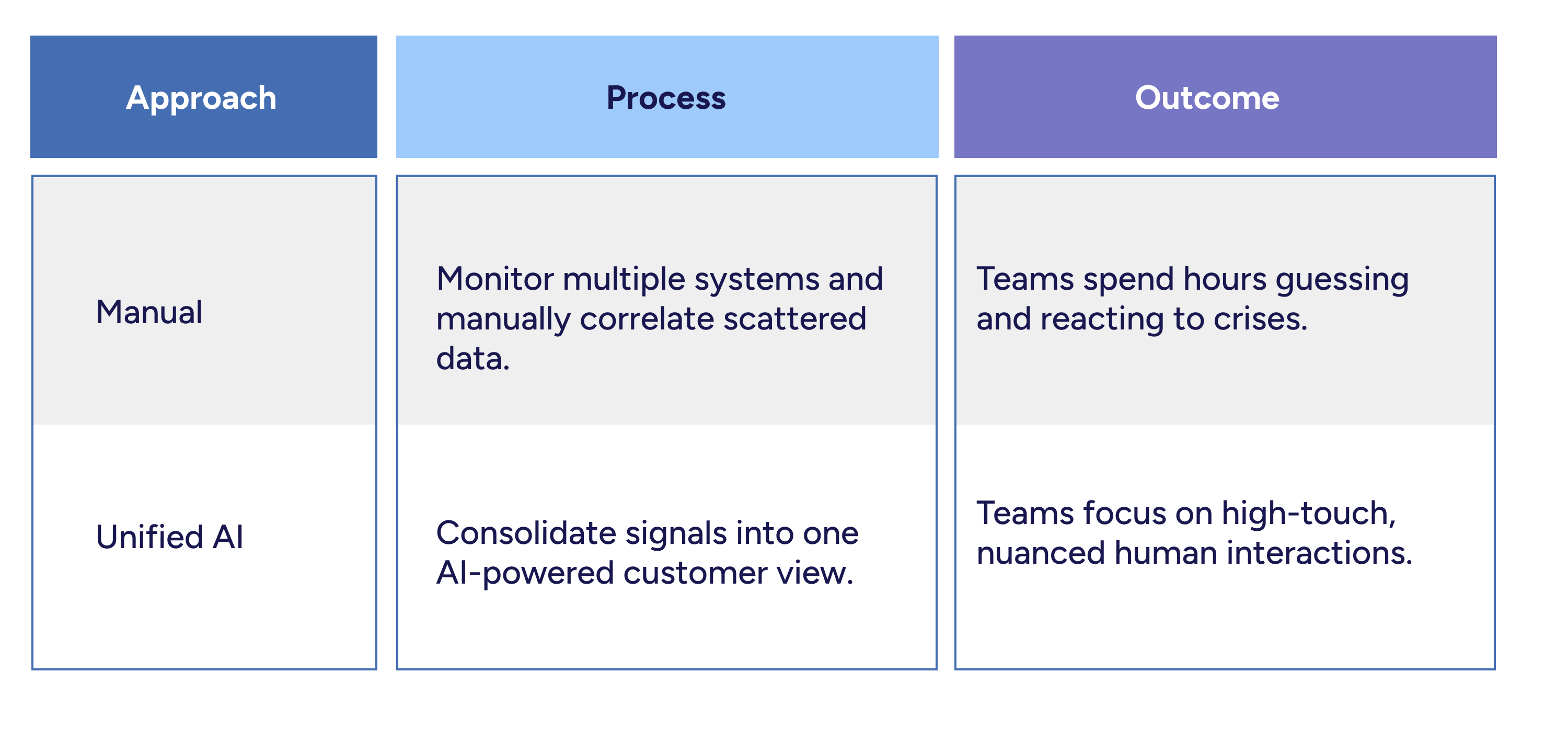
Manual vs. unified AI approach to churn prediction
Instead of your team spending hours collating data from different sources to spot patterns, they can focus on what humans do best: delivering high-touch, thoughtful customer interactions that require emotional intelligence and creative problem-solving.
They are also less likely to fall into the failure patterns outlined in these common CX mistakes.
The goal is not just to know who might leave. It is to know why they are at risk, what action should happen next, and who should own the intervention.
The best time to save a customer’s trust was yesterday. The next best time is now.
See how Lucidya helps CX teams connect customer signals, detect churn risk earlier, and trigger smarter retention workflows before valuable customers leave.
Customer churn prediction is a forward-looking method for identifying which current customers are most likely to cancel, stop buying, or disengage. It uses behavioral, support, sentiment, feedback, and account data to assign risk scores so teams can step in earlier.
How does customer churn prediction differ from calculating churn rate?
Churn rate is a historical metric. It tells you how many customers were lost during a past period. Customer churn prediction is forward-looking. It estimates which active customers are most likely to leave next, giving teams time to act.
What are the most reliable behavioral signals that predict churn?
The most reliable signals include declining usage, reduced feature adoption, unresolved support issues, repeated complaints, worsening sentiment, reduced purchase frequency, and silence after an issue was raised. Customers rarely announce churn directly. They usually show it in behavior first.
How does unified customer data improve churn prediction accuracy?
Fragmented data hides the pattern. When behavioral, support, feedback, social, and account signals are connected in one profile, weak signals become a visible trend. That helps teams detect risk earlier and respond with better context.
Can sentiment analysis help predict customer churn?
Yes. Negative shifts in social posts, survey open text, reviews, and support conversations often appear weeks or months before cancellation. Sentiment analysis helps CX teams detect frustration, disappointment, and declining trust early enough to trigger proactive outreach or service recovery.
How do CX teams act on churn risk scores?
CX teams act on churn risk scores by segmenting customers by risk level and matching each segment to a workflow. High-risk accounts may need proactive outreach, unresolved issues may need escalation, low-adoption users may need onboarding support, and renewal-risk customers may need a retention plan before the renewal window closes.
Lucidya is an AI-native customer experience management (CXM) platform that connects social listening, media monitoring, omnichannel customer service, a customer data platform, survey tools, and autonomous AI resolution into one system. The platform is built on proprietary NLP that processes Arabic natively across 17+ dialects with 92% sentiment accuracy, rather than relying on translation layers that lose nuance and context. Most enterprise CX teams run five or six separate tools to cover these functions, Lucidya replaces that stack with a single connected platform where every product shares the same data layer. The result: when your AI Agent resolves a customer case, it already knows that customer's sentiment history, social behavior, and full interaction record. When your PR team spots a brand mention in the news, that signal connects to the same platform handling customer service. Intelligence and action happen in one place.
What channels does Lucidya monitor?
Lucidya covers the full range of channels where customer conversations happen: social media (X, Instagram, Facebook, YouTube, TikTok, Snapchat), news and media (1,600+ online news sites, blogs, forums, print, TV, and radio), public reviews across 20+ platforms including Google Maps, Airbnb, TripAdvisor, Booking.com, Glassdoor, and G2, as well as WhatsApp, email, social DMs, live chat, voice and call center data, and survey and website feedback. Every channel feeds the same platform. So when something moves from social into news coverage, or from a WhatsApp complaint into a broader service pattern, your team sees it in one place rather than catching it late in a second tool.
What products make up the Lucidya platform?
Lucidya is six integrated products on one AI engine, deployable together or individually. Social Listening monitors brand mentions, competitor activity, and emerging trends across social channels in real time. Media Monitoring tracks brand presence across 1,600+ news, blog, forum, print, TV, and radio sources — the coverage that social-only tools miss. OmniServe is an omnichannel inbox that unifies messages from social media, WhatsApp, email, and live chat into one AI-powered workspace with sentiment-aware routing and full customer context for every agent. Profiles is a Customer Data Platform that builds 360-degree customer views by connecting behavioral, sentiment, interaction, and demographic data across all touchpoints. It combines customer identities and interactions from multiple channels into one centralized profile, so teams can see the full history of how a customer has engaged across social, support, surveys, and every other channel in one place. Survey collects and analyzes customer feedback across channels with AI-native sentiment analysis on open-text responses. AI Agent resolves customer cases end to end autonomously across WhatsApp, social media, and other channels, executing actions, completing workflows, and closing cases without human intervention. Role-based access controls, PII masking, audit trails, and a kill switch are built in for regulated industries.
How does Lucidya differ from other enterprise CX platforms?
Most enterprise CX platforms are built around one primary function, ticketing, social listening, or marketing, and require additional tools for everything else. Lucidya is built as a unified system from the ground up. Unified data layer. Every product shares the same underlying data. The AI Agent has access to social listening data. The omnichannel inbox connects to the CDP. Media monitoring feeds the same dashboard as social. This eliminates the data silos that make enterprise CX slow and reactive. Proactive by design. Lucidya's intelligence layer monitors brand mentions, tracks sentiment shifts, and surfaces competitor activity before customers contact you. Most platforms start at the ticket. Lucidya starts earlier. Modular adoption. Unlike platforms that require full migration to access AI capabilities, Lucidya's products can be adopted individually. Start with social listening, add the AI Agent later, without rebuilding your stack. Multilingual accuracy. Lucidya's AI engine achieves 92% sentiment accuracy in both English and Arabic, with native training across 17 Arabic dialects. For global brands operating in Arabic-speaking markets, this is the difference between accurate intelligence and confident noise.
What types of organizations use Lucidya?
Lucidya serves enterprise brands, government entities, and large organizations that need accurate, real-time customer intelligence at scale. Key sectors include banking and financial services, telecommunications, travel and tourism, insurance, hospitality, healthcare, and logistics. It is used by organizations that need proactive brand intelligence, not just reactive ticketing, and by regulated industries that require compliance-grade governance controls over their AI systems. For global enterprises operating in or expanding into Arabic-speaking markets, Lucidya provides the only CXM platform with native Arabic-language AI across 17 dialects.
How does Lucidya handle data privacy and compliance?
Lucidya complies with GDPR, CCPA/CPRA, Saudi PDPL, SOC 2 Type II, ISO/IEC 27001, ISO 27017, HIPAA Ready, NIST CSF, and Tier 2 CASA Verified standards, with regional data hosting available in Saudi Arabia and the GCC. This covers the core compliance requirements for enterprise deployments in the UK, US, EU, and Gulf markets. For organizations operating in Saudi Arabia and the GCC, Lucidya additionally holds SDAIA and NCA ECC/CCC certifications with regional data hosting options. All AI Agent actions are governed by a policy engine, logged in a full audit trail, and can be paused instantly. Role-based access controls and PII masking are built into the core platform.
How accurate is Lucidya's sentiment analysis?
Lucidya achieves 92% sentiment accuracy in both English and Arabic. For English-language markets, this means reliable sentiment detection across social, news, and customer service interactions without the false positives that degrade signal quality at scale. For Arabic-language markets, accuracy at this level requires native training rather than translation. Lucidya's NLP engine is trained on 17 Arabic dialects, covering Gulf Arabic (Khaleeji Arabic), Egyptian, Levantine, Maghrebi, and other regional variants, because sentiment in Arabic varies significantly across dialects. Tools that translate Arabic to English before analysis lose this nuance before any processing occurs. For global brands with operations in MENA, this is the accuracy gap that makes or breaks customer intelligence in the region.
What makes Lucidya a strong choice for global brands?
Global brands face a specific version of the fragmented CX problem, they need tools that work across markets, languages, and regulatory environments without requiring a different vendor for each region. Lucidya addresses this in three ways. One platform across channels. Social, news, messaging, live chat, surveys, and AI resolution in one system, regardless of which market you're operating in. Compliance built in. GDPR, CCPA, SOC 2, ISO 27001, and regional certifications for Gulf markets, covered in one platform rather than requiring separate compliance configurations per region. Multilingual AI that actually works. 92% sentiment accuracy in English and Arabic, with native dialect training rather than translation. For brands expanding into the Middle East, or already operating there, this is the capability that global-first platforms cannot replicate from a standing start.
Take the next step toward a smarter customer experience
Dive deeper with fresh perspectives for smarter CX

.svg)






.svg)




.svg)