.svg)



Marketing & Brand
Marketing cognitive biases: How hidden thinking patterns waste your budget
Learn how marketing cognitive biases quietly distort budget decisions, weaken strategy, and how teams can use real customer data to make better calls.
Learn how marketing cognitive biases quietly distort budget decisions, weaken strategy, and how teams can use real customer data to make better calls.


Marketing cognitive biases are predictable mental shortcuts that influence how marketers interpret information and make decisions. They create blind spots that lead to wasted budget, repeated mistakes, and strategies built on assumptions rather than evidence.
They also shape how customers interpret brands, messages, offers, and trust signals.
Understanding both sides helps teams move from assumption-led marketing to evidence-led decisions.
The five marketing cognitive biases that quietly waste budget are:
We have more data than marketers could have dreamed of a decade ago.
Attribution models track touchpoints. AI optimizes campaigns in real time. Platforms promise sharper targeting based on user behavior, intent signals, and audience data.
And yet the work still feels harder than it should.
The tools got smarter, but the human decision-making process did not become immune to bias. Attribution is messier, audiences are more fragmented, and the abundance of data intended to create clarity often creates more complexity.
The problem is often unconscious bias in marketing, not a lack of dashboards.
To cope, teams switch to autopilot. They lean on what feels familiar, what is easy to measure, or what supports the strategy already in motion. That can feel efficient, but it can also lead teams in the wrong direction.
The first step to better decisions is noticing these habits before they quietly shape your strategy.
Cognitive biases do not only distort internal marketing decisions. They also shape how customers interpret what they see.
On the team side, biases affect how marketers allocate budget, interpret data, evaluate campaigns, and respond to poor performance.
Confirmation bias pushes teams to defend what they already believe. Status quo bias keeps budget in familiar channels. Loss aversion delays difficult decisions. Vanity metrics pull attention toward visible activity instead of business impact. Information hoarding keeps customer insight trapped inside departments.
On the customer side, cognitive biases influence perception, trust, and choice.
Anchoring bias means the first price, promise, or comparison a customer sees can become the reference point for what feels reasonable.
Social proof makes reviews, peer recommendations, and visible adoption feel like evidence that a choice is safe.
The framing effect changes how an offer feels depending on how it is presented. “Save 20%” and “avoid losing 20%” can create different reactions even when the outcome is the same.
Loss aversion works on the customer side too. People often respond more strongly to what they might lose than to what they might gain.
Scarcity creates urgency, but only builds trust when the limitation is real.
Used ethically, these signals help marketers communicate value more clearly. Used carelessly, they damage trust.
That is also where Social Listening and real-time sentiment data matter. They help teams detect which trust signals, objections, and message frames are actually resonating instead of relying on generic playbooks.
Confirmation bias leads marketing teams to seek evidence that supports what they already believe while dismissing data that contradicts it.
In practice, campaigns are built on internal assumptions rather than customer reality. Budgets flow toward validating a strategy instead of testing it. Poor performance gets rationalized instead of addressed.
The antidote is structured assumption auditing: regularly presenting evidence that challenges the current strategy, not just evidence that supports it.
Our brains like being right more than being accurate. In marketing, that can mean favoring data that validates current positioning, rationalizing weak results, or dismissing audience feedback that does not fit the internal story.
The following scenarios are illustrative composites based on common patterns across marketing teams.
A B2B SaaS company spent heavily on a pricing strategy built around “enterprise-grade” positioning. The founder believed premium buyers cared most about security, reliability, and mission-critical infrastructure.
The pricing page reflected that belief. The messaging was polished, serious, and expensive-looking.
But customer interviews told a different story. The real audience was made up of small teams trying to replace several disconnected tools. They were not primarily asking for enterprise security. They were asking whether the product could simplify the chaos of daily operations.
The marketing team had been reading internal agreement as market validation. Every campaign reinforced the original assumption, while contradictory signals were treated as exceptions.
That is confirmation bias at work.
The goal is not to silence instinct. It is to interrogate it.
To reduce confirmation bias:
A practical habit is a monthly assumption audit. The team reviews what it believes, what evidence supports it, and what evidence challenges it.
Media monitoring can also help teams examine their brand narrative and pay attention to signals that challenge internal assumptions. Pair that with Social Listening to validate what audiences actually say in real time.
Status quo bias in marketing shows up when teams keep investing in familiar channels because those channels feel safe, measurable, or professionally comfortable, even after audience behavior has changed.
What worked before can quietly become the reason growth stalls.
Marketing teams often stay attached to channels they know how to optimize. Paid social, search, email, events, influencers, communities, newsletters, and partnerships can all become comfort zones. The danger begins when the team defends the channel instead of following the audience.
A performance marketing team relied heavily on paid social ads. For years, the channel had delivered clean attribution, clear reporting, and predictable optimization cycles.
But the audience had started moving elsewhere. Prospects were discovering solutions through YouTube creators, newsletters, podcasts, niche communities, and peer recommendations.
The data was messier. There were fewer clean click paths and more survey responses saying things like “I heard about you from a creator” or “I saw you in a newsletter.”
The team saw the shift. But the old channel felt safer because it was measurable.
So they optimized harder on the familiar platform while competitors built trust in the places where the audience had actually moved.
Breaking status quo bias requires curiosity and a willingness to question what feels familiar.
To reduce it:
Growth often hides in the places where certainty is weaker.
That is why zero- and first-party data matter. They help teams understand how audiences behave across owned and direct signals instead of relying only on platform-level reporting.
Loss aversion in marketing is the tendency for teams to continue investing in underperforming channels or campaigns because stopping feels like admitting failure.
This connects directly to the sunk cost fallacy. The more a team has already spent, the harder it becomes to walk away, even when the data supports reallocation.
The fix is setting clear success criteria and exit thresholds before launching any initiative, so the decision is made rationally before emotions take over.
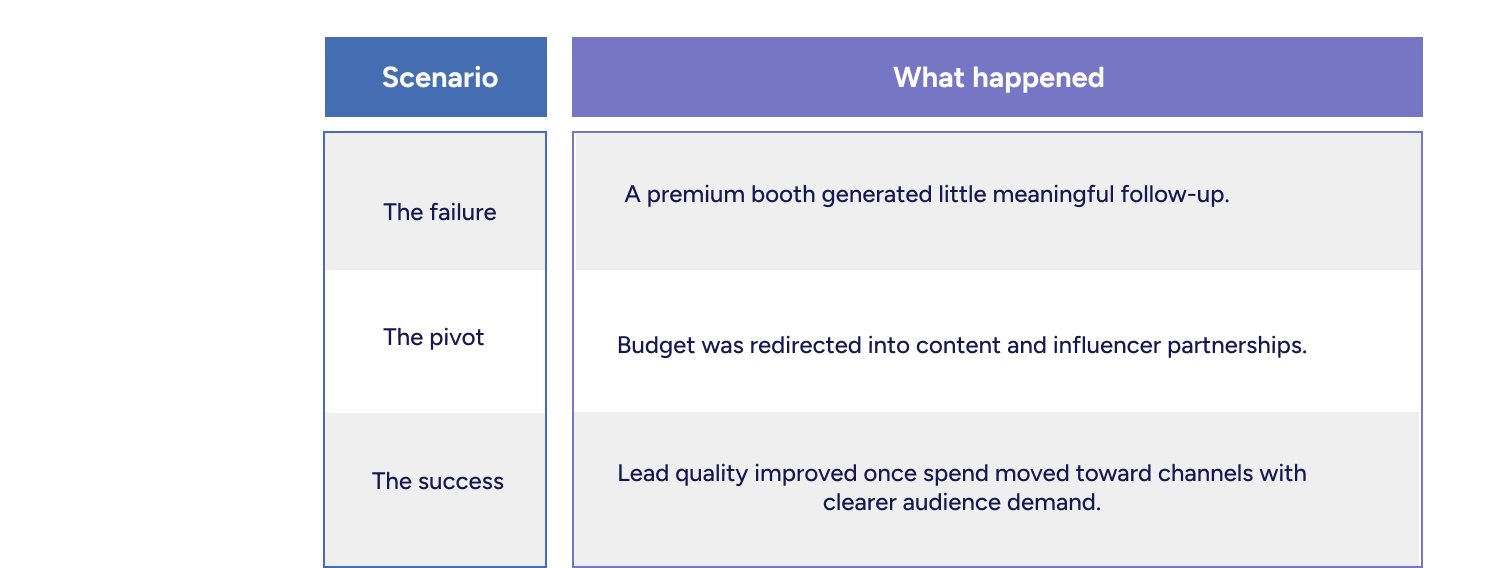
A travel technology company spent months debating whether to stop its annual trade show circuit. The team had invested in booths, travel, branded giveaways, and networking dinners for several cycles.
The problem was that the results were weak. The strongest leads were coming from content partnerships and organic search, not events.
But conferences felt important. Competitors were there. The industry expected a presence. The fear of missing a valuable executive conversation made it hard to stop.
Each quarterly review ended the same way: “Let’s see how the next show performs.”
That is how loss aversion drains budget. The pain of stopping feels more immediate than the opportunity cost of continuing.
Set stop or continue criteria before launching a campaign.
For example: “If this campaign does not generate a defined number of qualified leads within three months, we redirect the budget to an alternative channel.”
This makes the decision before the team becomes emotionally attached.
To reduce loss aversion:
Competitive intelligence can help teams avoid wasting money where others are already underperforming. Lucidya Social Listening can also surface competitor conversation and sentiment shifts as they happen.
Vanity metrics create a false sense of marketing performance because they are easy to measure and emotionally rewarding to track.
This is attentional bias at work. Teams optimize for what is most visible, such as likes, shares, impressions, comments, and follower counts, instead of slower-moving indicators that better predict business value.
Visible metrics are not useless. The problem is treating visibility as proof of impact.
An AI startup built a product for logistics companies. Its real buyers were operations leaders solving complex supply chain problems.
The marketing team started posting broad thought leadership content about AI transformation. The posts performed well on LinkedIn. They attracted likes, comments, and shares.
But the audience was wrong.
The content attracted AI enthusiasts, marketers, and general technology followers, not the operations leaders who could buy the product. The team had built visibility without pipeline.
Meanwhile, the less viral content, detailed case studies about supply chain optimization, attracted fewer reactions but better-fit prospects.
Availability made the loudest signal feel like the most important one.
Creative energy should not be exhausted in pursuit of visibility alone.
To reduce attentional bias:
Often, the most valuable audience members do not comment. They read, compare, and convert quietly.
That is why sentiment analysis and customer intelligence need to go beyond volume. What looks loud is not always what moves the market.
Information hoarding is an organizational decision-making bias that appears when teams protect their findings instead of sharing them.
The result is fragmented knowledge, duplicate effort, and a weaker view of the customer than any one team believes it has.
Siloed data reinforces cognitive bias because each team makes decisions based on an incomplete customer picture. When insights stay inside individual departments, contradictory evidence never reaches the people who need it. Flawed assumptions survive longer than they should.
A public-sector team discovered why people were abandoning a new digital application. The problem was not the technology. It was the language.
The forms, instructions, and announcements were too complex. People repeatedly contacted support for clarification that should have been available online.
The marketing team had valuable research, but the insights stayed mostly inside reports. Communications continued publishing unclear announcements. Customer service kept answering avoidable questions. Policy teams created new forms using the same confusing language.
Once the research was shared across departments, the experience improved. Messaging became clearer, service scripts were updated, and policies reflected real customer needs.
The issue was not lack of intelligence. It was trapped intelligence.
Set regular intelligence-sharing sessions where each team presents actionable findings, not just reports.
To reduce information hoarding:
Marketing is not the only source of insight. Other teams see patterns you might miss.
A shared system such as Profiles helps connect what different teams know, so the organization can act on one customer reality instead of several partial versions of it.
Marketers can reduce the impact of cognitive biases by building structural checks into their workflow instead of relying on willpower or intuition alone.
Effective marketing is not a test of perfect intuition. It is a test of humility.
The goal is not to eliminate bias completely. That is unrealistic. The goal is to build systems that make bias easier to detect, challenge, and correct.
A bias-resistant marketing team builds these habits into its workflow:
Test assumptions: Validate internal beliefs against observable customer data.
Honor results: Allow successful new paths to replace familiar rituals.
Pre-set criteria: Define stop or continue metrics before launching campaigns.
Filter noise: Give data enough time to settle before reacting to every fluctuation.
Prioritize actionable metrics: Ignore vanity stats that do not guide meaningful action.
Share insight across teams: Bring customer signals into one shared view instead of letting each department work from a different reality.
These habits reduce marketing decision-making bias by grounding teams in real customer signals instead of internal comfort.
Once you build these habits into the team’s operating rhythm, you stop betting on the myth of perfect instinct.
See how Lucidya helps marketing teams replace assumptions with real customer signals, so every budget decision is backed by clearer insight.
The most common marketing cognitive biases are confirmation bias, status quo bias, loss aversion, attentional bias toward vanity metrics, and information hoarding. Confirmation bias makes teams fund assumptions instead of evidence. Status quo bias keeps money in familiar channels after results decline. Loss aversion delays necessary cuts. Vanity metrics reward visibility over revenue, and information hoarding prevents teams from seeing the full customer picture.
Loss aversion is the fear of losing what you have, while sunk cost fallacy is the tendency to keep going because of what you have already spent. In practice, they often show up together. Teams keep running weak campaigns because stopping feels painful and because they do not want past spend, effort, or political capital to feel wasted.
Real-time customer data surfaces what audiences actually say and do instead of what marketers assume they think. Social listening, sentiment analysis, surveys, and unified customer profiles act as an external check on internal narratives. That makes it harder for confirmation bias and status quo bias to go unchallenged for months before budget damage becomes obvious.
Marketers can reduce unconscious bias by running assumption audits, setting decision criteria before campaigns launch, tracking engagement quality instead of volume, sharing insights across departments, and using customer data to challenge internal beliefs before they harden into strategy.


Lucidya is an AI-native customer experience management (CXM) platform that connects social listening, media monitoring, omnichannel customer service, a customer data platform, survey tools, and autonomous AI resolution into one system. The platform is built on proprietary NLP that processes Arabic natively across 17+ dialects with 92% sentiment accuracy, rather than relying on translation layers that lose nuance and context. Most enterprise CX teams run five or six separate tools to cover these functions, Lucidya replaces that stack with a single connected platform where every product shares the same data layer. The result: when your AI Agent resolves a customer case, it already knows that customer's sentiment history, social behavior, and full interaction record. When your PR team spots a brand mention in the news, that signal connects to the same platform handling customer service. Intelligence and action happen in one place.
Lucidya covers the full range of channels where customer conversations happen: social media (X, Instagram, Facebook, YouTube, TikTok, Snapchat), news and media (1,600+ online news sites, blogs, forums, print, TV, and radio), public reviews across 20+ platforms including Google Maps, Airbnb, TripAdvisor, Booking.com, Glassdoor, and G2, as well as WhatsApp, email, social DMs, live chat, voice and call center data, and survey and website feedback. Every channel feeds the same platform. So when something moves from social into news coverage, or from a WhatsApp complaint into a broader service pattern, your team sees it in one place rather than catching it late in a second tool.
Lucidya is six integrated products on one AI engine, deployable together or individually. Social Listening monitors brand mentions, competitor activity, and emerging trends across social channels in real time. Media Monitoring tracks brand presence across 1,600+ news, blog, forum, print, TV, and radio sources — the coverage that social-only tools miss. OmniServe is an omnichannel inbox that unifies messages from social media, WhatsApp, email, and live chat into one AI-powered workspace with sentiment-aware routing and full customer context for every agent. Profiles is a Customer Data Platform that builds 360-degree customer views by connecting behavioral, sentiment, interaction, and demographic data across all touchpoints. It combines customer identities and interactions from multiple channels into one centralized profile, so teams can see the full history of how a customer has engaged across social, support, surveys, and every other channel in one place. Survey collects and analyzes customer feedback across channels with AI-native sentiment analysis on open-text responses. AI Agent resolves customer cases end to end autonomously across WhatsApp, social media, and other channels, executing actions, completing workflows, and closing cases without human intervention. Role-based access controls, PII masking, audit trails, and a kill switch are built in for regulated industries.
Most enterprise CX platforms are built around one primary function, ticketing, social listening, or marketing, and require additional tools for everything else. Lucidya is built as a unified system from the ground up. Unified data layer. Every product shares the same underlying data. The AI Agent has access to social listening data. The omnichannel inbox connects to the CDP. Media monitoring feeds the same dashboard as social. This eliminates the data silos that make enterprise CX slow and reactive. Proactive by design. Lucidya's intelligence layer monitors brand mentions, tracks sentiment shifts, and surfaces competitor activity before customers contact you. Most platforms start at the ticket. Lucidya starts earlier. Modular adoption. Unlike platforms that require full migration to access AI capabilities, Lucidya's products can be adopted individually. Start with social listening, add the AI Agent later, without rebuilding your stack. Multilingual accuracy. Lucidya's AI engine achieves 92% sentiment accuracy in both English and Arabic, with native training across 17 Arabic dialects. For global brands operating in Arabic-speaking markets, this is the difference between accurate intelligence and confident noise.
Lucidya serves enterprise brands, government entities, and large organizations that need accurate, real-time customer intelligence at scale. Key sectors include banking and financial services, telecommunications, travel and tourism, insurance, hospitality, healthcare, and logistics. It is used by organizations that need proactive brand intelligence, not just reactive ticketing, and by regulated industries that require compliance-grade governance controls over their AI systems. For global enterprises operating in or expanding into Arabic-speaking markets, Lucidya provides the only CXM platform with native Arabic-language AI across 17 dialects.
Lucidya complies with GDPR, CCPA/CPRA, Saudi PDPL, SOC 2 Type II, ISO/IEC 27001, ISO 27017, HIPAA Ready, NIST CSF, and Tier 2 CASA Verified standards, with regional data hosting available in Saudi Arabia and the GCC. This covers the core compliance requirements for enterprise deployments in the UK, US, EU, and Gulf markets. For organizations operating in Saudi Arabia and the GCC, Lucidya additionally holds SDAIA and NCA ECC/CCC certifications with regional data hosting options. All AI Agent actions are governed by a policy engine, logged in a full audit trail, and can be paused instantly. Role-based access controls and PII masking are built into the core platform.
Lucidya achieves 92% sentiment accuracy in both English and Arabic. For English-language markets, this means reliable sentiment detection across social, news, and customer service interactions without the false positives that degrade signal quality at scale. For Arabic-language markets, accuracy at this level requires native training rather than translation. Lucidya's NLP engine is trained on 17 Arabic dialects, covering Gulf Arabic (Khaleeji Arabic), Egyptian, Levantine, Maghrebi, and other regional variants, because sentiment in Arabic varies significantly across dialects. Tools that translate Arabic to English before analysis lose this nuance before any processing occurs. For global brands with operations in MENA, this is the accuracy gap that makes or breaks customer intelligence in the region.
Global brands face a specific version of the fragmented CX problem, they need tools that work across markets, languages, and regulatory environments without requiring a different vendor for each region. Lucidya addresses this in three ways. One platform across channels. Social, news, messaging, live chat, surveys, and AI resolution in one system, regardless of which market you're operating in. Compliance built in. GDPR, CCPA, SOC 2, ISO 27001, and regional certifications for Gulf markets, covered in one platform rather than requiring separate compliance configurations per region. Multilingual AI that actually works. 92% sentiment accuracy in English and Arabic, with native dialect training rather than translation. For brands expanding into the Middle East, or already operating there, this is the capability that global-first platforms cannot replicate from a standing start.

.svg)


.svg)