.svg)



Customer Experience
Customer visibility in CX: Why teams need a unified customer view
Learn why customer visibility matters, how disconnected systems make customers repeat themselves, and how unified CX helps teams resolve issues faster.
Learn why customer visibility matters, how disconnected systems make customers repeat themselves, and how unified CX helps teams resolve issues faster.


“I’ve contacted support three times about this. Each time I have to explain everything from scratch, like I’m a new customer. Does anyone there actually talk to each other? I’m done.”
Sarah M., 7 hours ago
Customers repeat themselves when support channels, ticket history, CRM records, and previous interaction data are stored in disconnected systems. An agent handling a phone call may see the customer’s account, but not their prior email, chat conversation, survey response, or public complaint.
Without a unified view, every channel starts from zero.
This conversation is happening right now, somewhere in your organization, and probably several times today. Your agent is not incompetent, and your systems may not be technically broken. Something more fundamental is wrong: your customer experience is operating without enough visibility.
For years, the industry has obsessed over incomplete metrics: average handle time, first call resolution, queue wait times, and ticket volume. These numbers matter, but they are symptoms, not causes.
The real question is: what does your team actually see when a customer reaches out?
For many organizations, the honest answer is not enough.
Customer visibility drives better CX: Customers do not only want faster replies. They want teams to understand their history, context, and current need.
Fragmented tools create fragmented experiences: When data sits across disconnected systems, customers repeat themselves and agents make decisions with partial context.
Unified CX connects the journey: A unified CX platform brings conversations, history, feedback, sentiment, and workflows into one operating layer.
AI needs visibility to work: AI can only improve customer experience when it has access to connected data and full customer context.
The goal is not more tools: The goal is a shared customer view that helps teams resolve issues faster and more intelligently.
Customer visibility in CX is the ability to see a customer’s history, sentiment, interactions, feedback, and support context across every channel in one place.
It helps teams understand not only who the customer is, but what they have experienced, how they feel, what they need, and what should happen next.
Customer visibility is different from simply having customer data. Many organizations have plenty of data, but it is scattered across CRM systems, helpdesks, inboxes, analytics platforms, social channels, survey tools, and spreadsheets. Visibility happens when those signals are connected and made useful at the moment of interaction.
Without customer visibility, teams answer with fragments.
With customer visibility, teams respond with context.
When executives hear complaints about support, they often assume the problem is speed. The natural response is to hire more agents, optimize routing, automate replies, and shorten handling time.
But customers do not only complain because support is slow. They complain because support feels disconnected.
Vonage reports that 63% of customers are annoyed when they have to repeat their problem to multiple agents because context and personalized data are not attached to the issue.
That frustration matters because repeating the same story makes customers feel forgotten. It tells them the organization is not learning from previous interactions.
A faster reply does not fix that.
If the agent still lacks context, speed only helps the customer reach the same disconnected experience sooner.
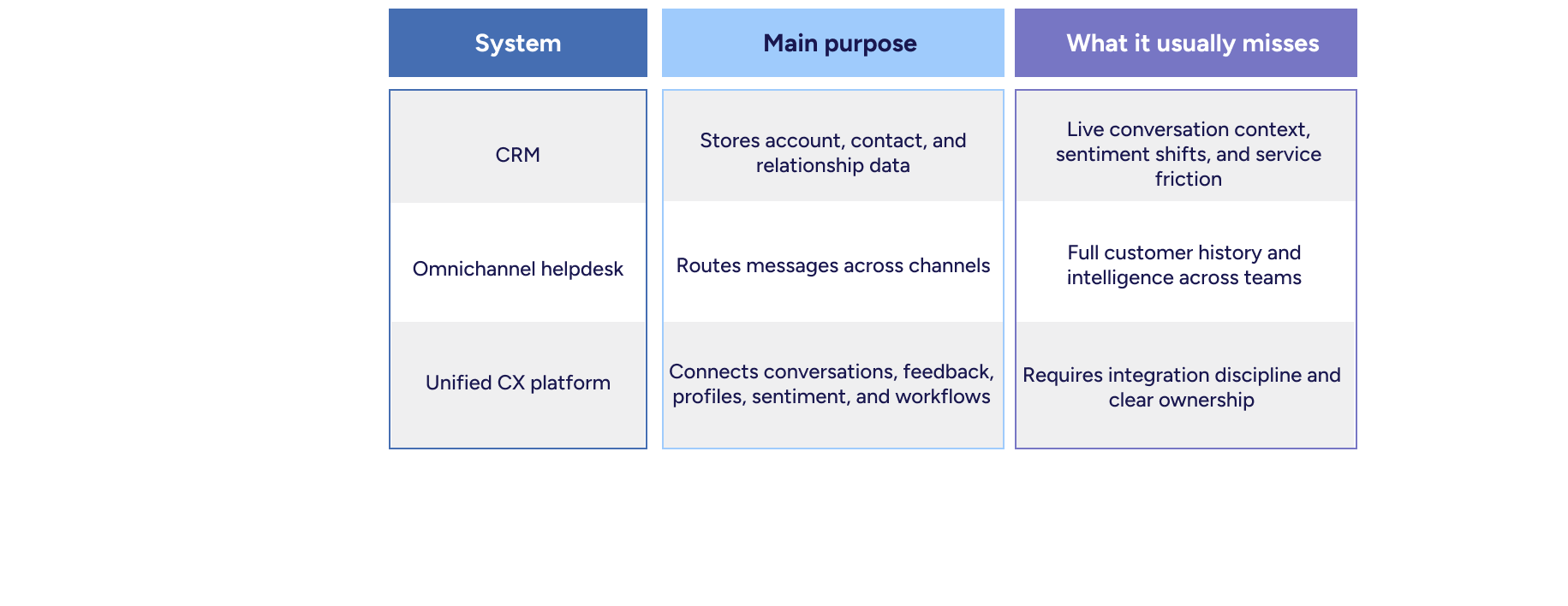
A unified customer experience platform connects customer conversations, interaction history, sentiment data, feedback, support workflows, and customer profiles across channels into one shared environment.
Unlike a CRM, which mainly stores relationship and account data, or an omnichannel helpdesk, which routes messages across channels, a unified CX platform connects the signals behind the interaction.
It helps service, marketing, CX, and leadership teams work from the same customer picture.
A CRM tells you who the customer is.
An omnichannel helpdesk tells you where the message came from.
A unified CX platform helps you understand what the customer has experienced, how they feel now, and what your team should do next.
Omnichannel support lets customers contact a brand through multiple channels.
Unified CX connects those channels with shared customer context, history, and sentiment so every interaction feels continuous.
The difference is not the number of channels available. It is whether intelligence travels with the customer across all of them.
When agents lack a complete customer view, support quality degrades in ways that compound across the business.
Customers repeat their history on every contact. Agents make decisions without the context needed to solve issues accurately. Dissatisfied customers churn before retention teams see the warning signs. Product and service intelligence dies inside disconnected systems instead of reaching the teams that could act on it.
The cost of poor customer visibility appears in four places.
By the time a customer calls to cancel, they have often already decided.
The warning signs appeared earlier: declining engagement, increasingly negative sentiment, shorter interactions, unresolved complaints, or repeated contact about the same issue.
Without visibility into those signals, retention teams fight battles that may already be lost.
McKinsey’s research on experience-led growth shows how improving customer experience can directly support lower churn and stronger revenue outcomes. In one transformation example, customer churn rates were cut by 75%, while revenues nearly doubled over three years.
The lesson is not that one initiative fixes churn. The lesson is that better visibility into customer needs helps organizations act before dissatisfaction becomes permanent.
Agents are often asked to solve problems without the information needed to understand them.
They search across tools, ask customers to repeat themselves, wait for internal updates, and take the blame for system gaps they did not create.
This is exhausting because the work becomes harder than it needs to be.
Customer support is already demanding. Fragmented systems make it feel impossible.
When agents have full context, they can focus less on detective work and more on resolution.
Many CX teams review only a small share of total interactions manually. Even when quality assurance is strong, sampling can still miss patterns hidden across chats, calls, emails, social conversations, surveys, and reviews.
That creates a dangerous problem: teams may make decisions based on the interactions they happened to review, not the full customer reality.
A unified CX platform helps solve this by connecting more customer signals into one view, making recurring issues, sentiment shifts, and journey friction easier to detect.
The visibility problem does not stop at the service desk.
When customer service operates separately from marketing, sales, and product teams, valuable intelligence stays trapped in departmental silos.
Product feedback buried in chat transcripts never reaches the roadmap.
Upsell opportunities flagged by support never reach sales.
Campaign complaints never reach marketing quickly enough.
The customer data that could improve the business exists in pieces, but no one sees the whole picture.
Organizations that improve CX do not only optimize for speed. They optimize for understanding.
Instead of asking only, “How fast did we close the ticket?” they ask:
The framework is simple, but it requires discipline.
Social comments, messaging conversations, support tickets, surveys, reviews, call notes, and CRM records should not live as separate realities.
Before teams can analyze customer experience accurately, they need to connect the data that describes it.
A name, phone number, and email address do not create a complete profile.
A useful customer profile includes interaction history, sentiment trends, stated preferences, purchase behavior, service history, and recent signals that explain the customer’s current context.
When service, marketing, sales, and CX all see the same picture, the customer finally feels known.
Knowing that a customer contacted support three times is useful.
Knowing that their sentiment shifted from neutral to frustrated over those three interactions is more useful.
Sentiment analysis helps teams see how customer emotion changes across time, not just whether a ticket was opened or closed.
Dashboards reviewed weekly will not help the customer waiting right now.
The best systems surface context during the interaction: previous complaints, unresolved issues, recent sentiment, likely intent, and recommended next steps.
Visibility only matters if it reaches the person who can act.
A single complaint may not signal a major issue.
Ten quiet complaints about the same friction point usually do.
When teams can analyze patterns across channels, they can identify the problems that repeat, prioritize what matters, and fix root causes instead of reacting to symptoms.
The conversation around AI in customer service often focuses on replacement. But the organizations seeing real value are using AI to make human teams smarter, faster, and more informed.
Gartner predicts that by 2029, agentic AI will autonomously resolve 80% of common customer service issues without human intervention, leading to a 30% reduction in operational costs.
But AI is only as useful as the visibility layer beneath it.
An AI assistant with fragmented data creates new problems. It may respond quickly but miss context, repeat old mistakes, or escalate too late.
An AI assistant with complete customer context can become far more useful. It can detect intent, prioritize urgency, route issues, summarize history, recommend next steps, and help teams resolve cases faster.
AI does not remove the need for customer visibility.
It makes customer visibility even more important.
Track the metrics that show whether your connected customer view is reducing effort instead of just moving work around.
Repeat contact rate: Shows whether customers still need to come back for the same issue.
First-contact resolution: Measures whether issues are resolved in the first interaction.
Customer effort score: Reveals how hard customers feel they have to work to get help.
Churn rate: Shows whether better visibility is improving retention.
Agent productivity: Measures whether agents resolve more cases with less manual searching.
Sentiment trend: Tracks whether customer tone improves or declines over time.
Resolution time: Measures how long it takes to solve the issue, not just respond.
Close-the-loop rate: Shows whether customers receive follow-up after their issue is addressed.
These metrics help teams see whether the customer experience is actually improving.
Your customer service performance problems may not be about speed alone.
They may be about sight.
Every disconnected system is a blind spot. Every interaction analyzed in isolation is a missed opportunity. Every agent operating without context is working harder than they should have to.
The question is not whether your customer experience is fast enough.
The question is whether your organization can see the customer clearly enough to help.
See how Lucidya helps teams eliminate customer blind spots by connecting conversations, feedback, sentiment, and customer data into one unified CX view.
Customer visibility is the ability to see a customer’s history, sentiment, interactions, feedback, and support context across channels in one place. It helps teams understand what the customer has experienced and what should happen next.
A unified CX platform connects customer conversations, profiles, feedback, sentiment, and workflows into one shared environment. It helps service, marketing, sales, and CX teams work from the same customer context.
It gives agents access to previous interactions, support history, customer sentiment, and relevant context before the conversation begins. That means customers do not need to re-explain the same issue every time they switch channels.
A CRM stores account and relationship data. A unified CX platform connects that data with live conversations, service history, feedback, sentiment, and workflows so teams can act on a complete customer picture.
Useful metrics include repeat contact rate, first-contact resolution, customer effort score, churn rate, sentiment trend, agent productivity, resolution time, and close-the-loop rate.
AI helps connect and interpret signals across conversations, feedback, support history, and sentiment. It can summarize context, detect intent, prioritize urgent cases, recommend next steps, and help teams resolve issues faster.


Lucidya is an AI-native customer experience management (CXM) platform that connects social listening, media monitoring, omnichannel customer service, a customer data platform, survey tools, and autonomous AI resolution into one system. The platform is built on proprietary NLP that processes Arabic natively across 17+ dialects with 92% sentiment accuracy, rather than relying on translation layers that lose nuance and context. Most enterprise CX teams run five or six separate tools to cover these functions, Lucidya replaces that stack with a single connected platform where every product shares the same data layer. The result: when your AI Agent resolves a customer case, it already knows that customer's sentiment history, social behavior, and full interaction record. When your PR team spots a brand mention in the news, that signal connects to the same platform handling customer service. Intelligence and action happen in one place.
Lucidya covers the full range of channels where customer conversations happen: social media (X, Instagram, Facebook, YouTube, TikTok, Snapchat), news and media (1,600+ online news sites, blogs, forums, print, TV, and radio), public reviews across 20+ platforms including Google Maps, Airbnb, TripAdvisor, Booking.com, Glassdoor, and G2, as well as WhatsApp, email, social DMs, live chat, voice and call center data, and survey and website feedback. Every channel feeds the same platform. So when something moves from social into news coverage, or from a WhatsApp complaint into a broader service pattern, your team sees it in one place rather than catching it late in a second tool.
Lucidya is six integrated products on one AI engine, deployable together or individually. Social Listening monitors brand mentions, competitor activity, and emerging trends across social channels in real time. Media Monitoring tracks brand presence across 1,600+ news, blog, forum, print, TV, and radio sources — the coverage that social-only tools miss. OmniServe is an omnichannel inbox that unifies messages from social media, WhatsApp, email, and live chat into one AI-powered workspace with sentiment-aware routing and full customer context for every agent. Profiles is a Customer Data Platform that builds 360-degree customer views by connecting behavioral, sentiment, interaction, and demographic data across all touchpoints. It combines customer identities and interactions from multiple channels into one centralized profile, so teams can see the full history of how a customer has engaged across social, support, surveys, and every other channel in one place. Survey collects and analyzes customer feedback across channels with AI-native sentiment analysis on open-text responses. AI Agent resolves customer cases end to end autonomously across WhatsApp, social media, and other channels, executing actions, completing workflows, and closing cases without human intervention. Role-based access controls, PII masking, audit trails, and a kill switch are built in for regulated industries.
Most enterprise CX platforms are built around one primary function, ticketing, social listening, or marketing, and require additional tools for everything else. Lucidya is built as a unified system from the ground up. Unified data layer. Every product shares the same underlying data. The AI Agent has access to social listening data. The omnichannel inbox connects to the CDP. Media monitoring feeds the same dashboard as social. This eliminates the data silos that make enterprise CX slow and reactive. Proactive by design. Lucidya's intelligence layer monitors brand mentions, tracks sentiment shifts, and surfaces competitor activity before customers contact you. Most platforms start at the ticket. Lucidya starts earlier. Modular adoption. Unlike platforms that require full migration to access AI capabilities, Lucidya's products can be adopted individually. Start with social listening, add the AI Agent later, without rebuilding your stack. Multilingual accuracy. Lucidya's AI engine achieves 92% sentiment accuracy in both English and Arabic, with native training across 17 Arabic dialects. For global brands operating in Arabic-speaking markets, this is the difference between accurate intelligence and confident noise.
Lucidya serves enterprise brands, government entities, and large organizations that need accurate, real-time customer intelligence at scale. Key sectors include banking and financial services, telecommunications, travel and tourism, insurance, hospitality, healthcare, and logistics. It is used by organizations that need proactive brand intelligence, not just reactive ticketing, and by regulated industries that require compliance-grade governance controls over their AI systems. For global enterprises operating in or expanding into Arabic-speaking markets, Lucidya provides the only CXM platform with native Arabic-language AI across 17 dialects.
Lucidya complies with GDPR, CCPA/CPRA, Saudi PDPL, SOC 2 Type II, ISO/IEC 27001, ISO 27017, HIPAA Ready, NIST CSF, and Tier 2 CASA Verified standards, with regional data hosting available in Saudi Arabia and the GCC. This covers the core compliance requirements for enterprise deployments in the UK, US, EU, and Gulf markets. For organizations operating in Saudi Arabia and the GCC, Lucidya additionally holds SDAIA and NCA ECC/CCC certifications with regional data hosting options. All AI Agent actions are governed by a policy engine, logged in a full audit trail, and can be paused instantly. Role-based access controls and PII masking are built into the core platform.
Lucidya achieves 92% sentiment accuracy in both English and Arabic. For English-language markets, this means reliable sentiment detection across social, news, and customer service interactions without the false positives that degrade signal quality at scale. For Arabic-language markets, accuracy at this level requires native training rather than translation. Lucidya's NLP engine is trained on 17 Arabic dialects, covering Gulf Arabic (Khaleeji Arabic), Egyptian, Levantine, Maghrebi, and other regional variants, because sentiment in Arabic varies significantly across dialects. Tools that translate Arabic to English before analysis lose this nuance before any processing occurs. For global brands with operations in MENA, this is the accuracy gap that makes or breaks customer intelligence in the region.
Global brands face a specific version of the fragmented CX problem, they need tools that work across markets, languages, and regulatory environments without requiring a different vendor for each region. Lucidya addresses this in three ways. One platform across channels. Social, news, messaging, live chat, surveys, and AI resolution in one system, regardless of which market you're operating in. Compliance built in. GDPR, CCPA, SOC 2, ISO 27001, and regional certifications for Gulf markets, covered in one platform rather than requiring separate compliance configurations per region. Multilingual AI that actually works. 92% sentiment accuracy in English and Arabic, with native dialect training rather than translation. For brands expanding into the Middle East, or already operating there, this is the capability that global-first platforms cannot replicate from a standing start.

.svg)

.svg)