.svg)



Marketing & Brand
Zero- and first-party data strategy: How marketers build trust and personalization
Learn how zero- and first-party data help marketers build trust, personalize smarter, and reduce dependence on unreliable third-party signals.
Learn how zero- and first-party data help marketers build trust, personalize smarter, and reduce dependence on unreliable third-party signals.


Many marketers are still treating data like an all-you-can-eat buffet.
“More stations. More varieties. More options.” They pile their plates high with website visits, bounce rates, ad impressions, email opens, click-through rates, social media engagements, and third-party data, hoping quantity will somehow transform into quality insights.
But the dining experience is changing.
Customers are more aware of how their data is collected and used. According to HubSpot’s data privacy research, close to half of consumers distrust companies with their website behavior and cookie data.
At the same time, third-party tracking has become harder to rely on. Google shifted away from a universal third-party cookie phaseout in Chrome, while Reuters reported in 2025 that Google would not move forward with a standalone third-party cookie prompt. Privacy-focused browser changes are also reshaping the landscape, with Firefox disabling cross-site tracking cookies by default.
The lesson for marketers is clear: third-party data is no longer a stable foundation for sustainable engagement.
Zero- and first-party data offer a stronger path forward. These are signals customers share directly or generate through interactions with channels your brand owns. They are more accurate, more transparent, and better suited to personalization built on trust.
According to Think with Google’s first-party data playbook, brands that deployed all four first-party data activation methods achieved 2.9x more revenue compared with brands that did not deploy those activations.
Because transparency builds trust. Trust encourages sharing. And sharing enables the kind of personalization that makes customers stay long after cookies stop being the main course.
The shift is already happening: Privacy expectations, browser changes, and customer distrust are pushing marketers toward owned, consent-based data.
Zero- and first-party data work together: Zero-party data shows what customers say they want. First-party data shows what they actually do.
Trust is a marketing advantage: Transparent data collection creates a better value exchange between brands and customers.
A single customer view matters: Data only becomes useful when it is connected across systems and teams.
Activation is the goal: The value of owned data comes from using it to personalize campaigns, improve service, and make smarter decisions.
A first-party data strategy is a structured plan for collecting, organizing, governing, and activating customer data from channels a brand owns and controls directly.
This includes websites, apps, CRM systems, surveys, loyalty programs, support interactions, email engagement, purchase history, and owned customer conversations.
The goal is to build accurate, consent-based customer profiles that improve personalization, reduce dependence on third-party data, and strengthen both marketing performance and customer trust.
Marketers need a first-party data strategy because customer data is becoming harder to borrow and more important to earn. Brands that build direct, transparent relationships with customers are better prepared for a privacy-led marketing future.
In practical terms, this means moving from isolated records and campaign-by-campaign guesswork to a repeatable system for collecting owned customer signals, connecting them across teams, and using them to improve customer experiences in real time.
Zero-party data is information customers intentionally share with a brand. First-party data is collected from customer behavior on owned channels. Second-party data is another company’s first-party data shared through a trusted partnership. Third-party data comes from external aggregators or brokers.
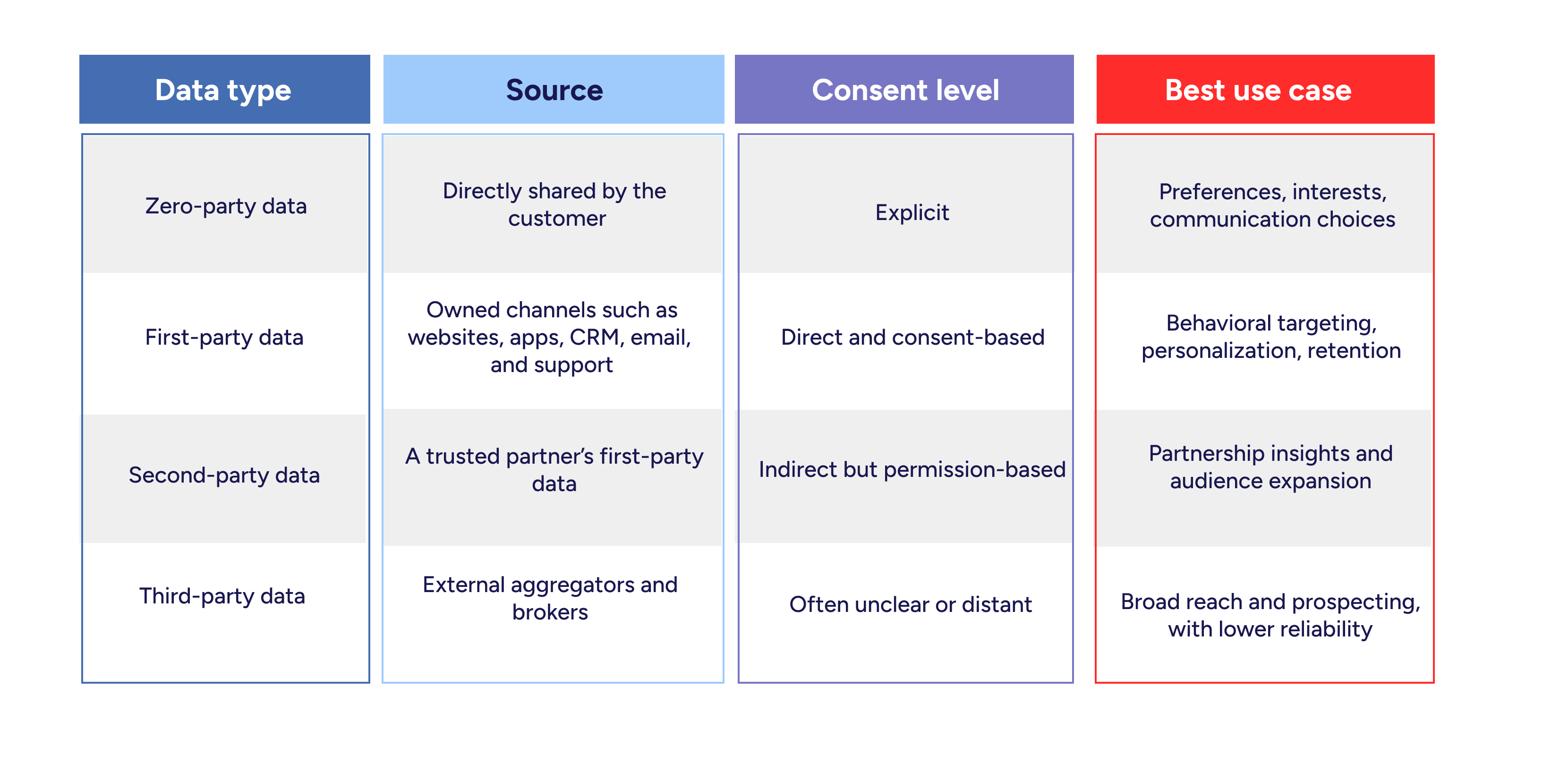
Zero-party data is explicitly provided by the customer. First-party data is observed through the customer’s behavior on owned channels.
Zero-party data tells you what customers say they want. First-party data shows what they actually do. The two are complementary: stated preferences reveal intent, while behavioral signals validate it.
Zero-party data: Information customers intentionally share, such as preferences, survey answers, quiz responses, and communication choices.
First-party data: Information collected from owned interactions, such as website visits, purchases, email engagement, CRM records, and support history.
Best practice: Use zero-party data to understand what customers say they want, and first-party data to validate what they actually do.
Third-party data has been marketing’s go-to solution for years. But this model is now weaker than it used to be for three reasons: technical instability, regulatory pressure, and declining customer trust.
From a technical perspective, browser changes continue to make third-party tracking less predictable. Chrome still represents a large share of global browser usage, with StatCounter showing Chrome at 68.02% worldwide in April 2026. That means Google’s changing approach to cookies affects the whole digital advertising ecosystem.
From a legal and regulatory perspective, privacy laws such as GDPR and CCPA have raised expectations around consent, transparency, and customer control.
From a customer perspective, unclear tracking practices damage trust. Customers are more likely to share data when the value exchange is visible: better recommendations, faster support, more relevant offers, or a smoother experience.
Beyond privacy and trust, third-party data also has practical flaws:
Identity quality: It can misidentify users, confuse multiple people using the same device, or degrade as cookies are cleared.
Usability: It often arrives disconnected from your own systems, making it harder to activate across campaigns, support, and CRM workflows.
Relevance: It usually reflects inferred or aggregated signals, not direct customer relationships.
The most significant problem is trust. Brands that openly gather information, give customers control, and offer fair value in return earn better access to better data. Those that operate in the shadows risk losing both.
Many brands already have valuable customer data. The problem is that it often lives across disconnected systems.
Your first-party data may already exist in:
This is the gold in your own backyard.
A customer may tell you what they want in a survey, show what they care about through website behavior, reveal frustration in a support ticket, and respond to a campaign weeks later. If those signals stay separated, your teams only see fragments.
A first-party data strategy connects those fragments into a clearer customer picture.
Building a first-party data strategy means creating a repeatable system for collecting, connecting, and activating owned customer signals.
Start with the outcomes you want to improve. Are you trying to increase conversion, improve retention, reduce churn, improve lead quality, or make customer engagement more relevant?
A strong data strategy starts with a business question, not a dashboard.
Identify what you already collect across CRM, web, app, email, surveys, support, commerce, and messaging systems.
This will show where your strongest customer signals live and where your gaps remain.
Look at where customers discover, evaluate, buy, ask for help, return, and recommend.
Every touchpoint is a potential source of first-party data collection, but it is also a moment where consent and context matter.
Customers are more willing to share data when the benefit is clear.
Preference centers, loyalty rewards, better service, relevant recommendations, and faster support all make the exchange feel fair.
If the data stays scattered, the strategy stays weak.
Bring owned data together into unified customer profiles so teams can act on one current view instead of disconnected records.
Move beyond static demographics.
Use observed behavior, stated preferences, and sentiment signals to build segments that reflect real needs, timing, and readiness to act.
Insights only matter when they change what the customer experiences.
Use first-party data to personalize campaigns, guide support, prioritize outreach, and coordinate the next best action across teams.
Track conversion rate, customer lifetime value, repeat purchase rate, churn rate, engagement rate, cost per acquisition, and campaign ROI.
Improvement across these metrics shows that your data is being collected, unified, and activated effectively.
A single customer view is a unified, real-time profile that consolidates available data about an individual customer from every channel and interaction into one record.
First-party data is the foundation of this view because it comes from owned channels where the brand controls collection, storage, and activation.
The harsh truth is that even the best customer data provides limited value when it is trapped in disconnected systems.
Data silos create blind spots across your stack:
Email platforms track opens but miss website behavior.
CRM systems track conversations but may miss support history.
Analytics tools measure page views but may miss offline interactions.
Support platforms capture service issues but may not inform marketing journeys.
According to BCG’s research on digital marketing maturity, less than a third of marketers have mastered accessing and integrating data across channels.
That disconnect creates real experience problems. A customer tells you they are interested in Product A through a survey, but your sales team calls about Product B. Or your company sends a “How is your new purchase working out?” email on the same day the customer filed a support ticket about that product.
These gaps happen because many companies still follow an outdated model:
Collect → Store → Analyze → Maybe Act
A stronger model is cyclical:
Connect: Unify data sources through Profiles.
Contextualize: Understand the why behind the data through surveys, social signals, and sentiment.
Segment: Group customers by intent, behavior, and value.
Personalize: Deliver relevant experiences across marketing, sales, and service.
Iterate: Refine based on results and fresh customer signals.
Repeat: Keep improving through continuous optimization.
Each cycle feeds the next. Over time, your messages become more relevant, your results clearer, and your relationship with customers stronger.
Marketers use zero- and first-party data to personalize customer experiences at scale by combining what customers say they want with what their behavior shows.
Together, these signals enable real-time segmentation, triggered messaging, dynamic content, and AI-driven recommendations based on actual customer intent rather than inferred demographics.
A strong first-party data strategy helps teams create:
Better-timed email experiences: Messages arrive when they are useful, not just when the campaign calendar says they should.
More relevant content: Content teams can create around known interests and needs instead of guessing which topics might land.
Smarter social engagement: Social teams can tailor responses and campaigns to audience segments that genuinely care.
Stronger product messaging: Product marketing can speak to real pain points instead of listing features in the abstract.
More relevant offers: Performance teams can reduce wasted spend and invest more in segments showing proven interest.
More personalized service: Support teams can see history, preferences, and recent signals before responding.
The shift to zero- and first-party data aligns good business with good ethics. Customer trust, data quality, and personalization all reinforce each other in a virtuous cycle.
Your competition may still be debating cookieless strategies while you are building something far more valuable: a business customers actively want to share data with.
That is not just better marketing. It is a more resilient foundation for customer relationships.
Lucidya helps brands turn owned customer data into clearer profiles, smarter segmentation, and more relevant action across the customer journey.
Profiles gives brands a unified customer view across behavioral, survey, CRM, and support data, turning scattered records into usable intelligence.
Survey helps collect zero-party data directly from customers through surveys, feedback forms, and structured responses.
Social Listening captures real-time signals from brand conversations, owned social interactions, and public audience discussions, adding context around sentiment, intent, and emerging issues.
OmniServe enriches customer profiles with support interaction history, complaint patterns, and live service context so teams can personalize with awareness of what the customer has already experienced.
AI Agent helps teams turn unified profiles into action by supporting more relevant next steps across channels.
Fragmented customer profiles lead to surface-level personalization and wasted spend. With Lucidya Profiles and the broader Lucidya platform, brands can turn consent-based data into coherent journeys that feel like a natural extension of the customer relationship.
First-party data is information a brand collects directly from customers through channels it owns and controls. Examples include purchase history, website behavior, email engagement, CRM records, app usage, and support history.
Zero-party data is intentionally shared by the customer, such as preferences, interests, or communication choices. First-party data is observed from customer behavior, such as clicks, purchases, app activity, and support interactions.
Brands collect zero-party data through surveys, preference centers, product quizzes, account setup questions, feedback forms, loyalty program enrollment, and direct customer conversations. The best exchanges are transparent and give customers something useful in return.
First-party data shows what customers actually do, buy, prefer, and need across owned channels. That allows brands to tailor messages, timing, offers, and support based on real signals instead of weak assumptions.
Common tools include customer data platforms, CRMs, data warehouses, consent management platforms, marketing automation tools, social listening platforms, and survey tools. Lucidya Profiles helps support unified customer intelligence by connecting customer signals into a single view.
First-party data does not rely on third-party cookies. It is collected directly from owned channels and stored in systems the brand controls, which makes it more resilient as browser restrictions and privacy expectations increase.
Key metrics include conversion rate, customer lifetime value, repeat purchase rate, churn rate, engagement rate, cost per acquisition, and campaign ROI. Over time, improvement across these measures shows that customer data is being collected, unified, and activated effectively.


Lucidya is an AI-native customer experience management (CXM) platform that connects social listening, media monitoring, omnichannel customer service, a customer data platform, survey tools, and autonomous AI resolution into one system. The platform is built on proprietary NLP that processes Arabic natively across 17+ dialects with 92% sentiment accuracy, rather than relying on translation layers that lose nuance and context. Most enterprise CX teams run five or six separate tools to cover these functions, Lucidya replaces that stack with a single connected platform where every product shares the same data layer. The result: when your AI Agent resolves a customer case, it already knows that customer's sentiment history, social behavior, and full interaction record. When your PR team spots a brand mention in the news, that signal connects to the same platform handling customer service. Intelligence and action happen in one place.
Lucidya covers the full range of channels where customer conversations happen: social media (X, Instagram, Facebook, YouTube, TikTok, Snapchat), news and media (1,600+ online news sites, blogs, forums, print, TV, and radio), public reviews across 20+ platforms including Google Maps, Airbnb, TripAdvisor, Booking.com, Glassdoor, and G2, as well as WhatsApp, email, social DMs, live chat, voice and call center data, and survey and website feedback. Every channel feeds the same platform. So when something moves from social into news coverage, or from a WhatsApp complaint into a broader service pattern, your team sees it in one place rather than catching it late in a second tool.
Lucidya is six integrated products on one AI engine, deployable together or individually. Social Listening monitors brand mentions, competitor activity, and emerging trends across social channels in real time. Media Monitoring tracks brand presence across 1,600+ news, blog, forum, print, TV, and radio sources — the coverage that social-only tools miss. OmniServe is an omnichannel inbox that unifies messages from social media, WhatsApp, email, and live chat into one AI-powered workspace with sentiment-aware routing and full customer context for every agent. Profiles is a Customer Data Platform that builds 360-degree customer views by connecting behavioral, sentiment, interaction, and demographic data across all touchpoints. It combines customer identities and interactions from multiple channels into one centralized profile, so teams can see the full history of how a customer has engaged across social, support, surveys, and every other channel in one place. Survey collects and analyzes customer feedback across channels with AI-native sentiment analysis on open-text responses. AI Agent resolves customer cases end to end autonomously across WhatsApp, social media, and other channels, executing actions, completing workflows, and closing cases without human intervention. Role-based access controls, PII masking, audit trails, and a kill switch are built in for regulated industries.
Most enterprise CX platforms are built around one primary function, ticketing, social listening, or marketing, and require additional tools for everything else. Lucidya is built as a unified system from the ground up. Unified data layer. Every product shares the same underlying data. The AI Agent has access to social listening data. The omnichannel inbox connects to the CDP. Media monitoring feeds the same dashboard as social. This eliminates the data silos that make enterprise CX slow and reactive. Proactive by design. Lucidya's intelligence layer monitors brand mentions, tracks sentiment shifts, and surfaces competitor activity before customers contact you. Most platforms start at the ticket. Lucidya starts earlier. Modular adoption. Unlike platforms that require full migration to access AI capabilities, Lucidya's products can be adopted individually. Start with social listening, add the AI Agent later, without rebuilding your stack. Multilingual accuracy. Lucidya's AI engine achieves 92% sentiment accuracy in both English and Arabic, with native training across 17 Arabic dialects. For global brands operating in Arabic-speaking markets, this is the difference between accurate intelligence and confident noise.
Lucidya serves enterprise brands, government entities, and large organizations that need accurate, real-time customer intelligence at scale. Key sectors include banking and financial services, telecommunications, travel and tourism, insurance, hospitality, healthcare, and logistics. It is used by organizations that need proactive brand intelligence, not just reactive ticketing, and by regulated industries that require compliance-grade governance controls over their AI systems. For global enterprises operating in or expanding into Arabic-speaking markets, Lucidya provides the only CXM platform with native Arabic-language AI across 17 dialects.
Lucidya complies with GDPR, CCPA/CPRA, Saudi PDPL, SOC 2 Type II, ISO/IEC 27001, ISO 27017, HIPAA Ready, NIST CSF, and Tier 2 CASA Verified standards, with regional data hosting available in Saudi Arabia and the GCC. This covers the core compliance requirements for enterprise deployments in the UK, US, EU, and Gulf markets. For organizations operating in Saudi Arabia and the GCC, Lucidya additionally holds SDAIA and NCA ECC/CCC certifications with regional data hosting options. All AI Agent actions are governed by a policy engine, logged in a full audit trail, and can be paused instantly. Role-based access controls and PII masking are built into the core platform.
Lucidya achieves 92% sentiment accuracy in both English and Arabic. For English-language markets, this means reliable sentiment detection across social, news, and customer service interactions without the false positives that degrade signal quality at scale. For Arabic-language markets, accuracy at this level requires native training rather than translation. Lucidya's NLP engine is trained on 17 Arabic dialects, covering Gulf Arabic (Khaleeji Arabic), Egyptian, Levantine, Maghrebi, and other regional variants, because sentiment in Arabic varies significantly across dialects. Tools that translate Arabic to English before analysis lose this nuance before any processing occurs. For global brands with operations in MENA, this is the accuracy gap that makes or breaks customer intelligence in the region.
Global brands face a specific version of the fragmented CX problem, they need tools that work across markets, languages, and regulatory environments without requiring a different vendor for each region. Lucidya addresses this in three ways. One platform across channels. Social, news, messaging, live chat, surveys, and AI resolution in one system, regardless of which market you're operating in. Compliance built in. GDPR, CCPA, SOC 2, ISO 27001, and regional certifications for Gulf markets, covered in one platform rather than requiring separate compliance configurations per region. Multilingual AI that actually works. 92% sentiment accuracy in English and Arabic, with native dialect training rather than translation. For brands expanding into the Middle East, or already operating there, this is the capability that global-first platforms cannot replicate from a standing start.

.svg)


.svg)