Competitive intelligence strategy: How to learn from the market and move before competitors do
Learn how a competitive intelligence strategy helps teams track market signals, learn from competitors, and turn insights into faster business decisions.
July 23, 2025
|
13
min read
|
Author:
Nagham Tawk
As Andrew Grove, former CEO of Intel, once said: “Only the paranoid survive.”
Imagine playing chess blindfolded. Every move feels confident until you realize the board has changed. Your queen is gone. Your opponent is five moves ahead.
That is what running a business without competitive intelligence looks like.
The window for action is shorter than ever. Customers do not wait, and they are not comparing you only to your closest competitor anymore. They are comparing you to the best experience they have ever had.
Competitive intelligence is not a crystal ball. It is a system. A practice. A discipline. It helps teams decode market signals, track competitor moves, understand customer sentiment, and make decisions based on evidence rather than instinct.
The question is not whether your business needs competitive intelligence. The question is how quickly your team can turn it into action.
Key takeaways
Competitive intelligence is a system: It is not a one-time report, but an ongoing process for tracking competitors, markets, customers, and business signals.
CI is not copying: The goal is to learn from competitor wins and failures, then use those insights to sharpen your own strategy.
Market signals matter: Product launches, pricing changes, customer sentiment, media coverage, reviews, and sales feedback all reveal where the market is moving.
Action is the differentiator: Competitive intelligence only creates value when insights reach the right team in time to influence decisions.
AI improves speed and clarity: AI-powered tools help teams monitor large volumes of competitor, customer, and market signals without relying on manual research alone.
What is competitive intelligence?
Competitive intelligence is the process of collecting, analyzing, and acting on information about competitors, customers, and market conditions to make better business decisions.
It goes beyond tracking competitor social posts or campaign launches. A strong competitive intelligence program monitors product changes, pricing moves, messaging shifts, customer sentiment, media coverage, reviews, sales feedback, and broader market signals.
In practice, competitive intelligence gives teams strategic situational awareness. It helps them understand where the market is moving, what competitors are doing, how customers are reacting, and which decisions need to happen next.
Gartner defines competitive and market intelligence tools as platforms that help organizations track, collect, store, analyze, and share insights from internal and external sources about competitors, markets, and customers. These sources can include news, social media, websites, industry databases, syndicated research, and financial filings. Gartner’s market overview reflects the growing importance of structured tools in this category.
Competitive intelligence is not an occasional tactic. It is an operating advantage.
What is a competitive intelligence strategy?
A competitive intelligence strategy is a structured plan that defines what to monitor, which competitors and markets matter most, how insights will be analyzed, who receives them, and how those insights translate into business action.
Without a strategy, competitive intelligence becomes a collection of disconnected observations. With one, it becomes a repeatable system that improves decisions across marketing, product, sales, customer experience, and leadership.
A strong CI strategy helps brands:
Sharpen positioning
Time campaigns more effectively
Fill product and service gaps
Support sales conversations
Monitor competitor moves
Detect reputation risks early
Respond faster to market changes
The difference is not access to more data. It is having a clear model for deciding what matters, who acts on it, and how fast teams move.
Competitive intelligence vs. competitor analysis vs. market research
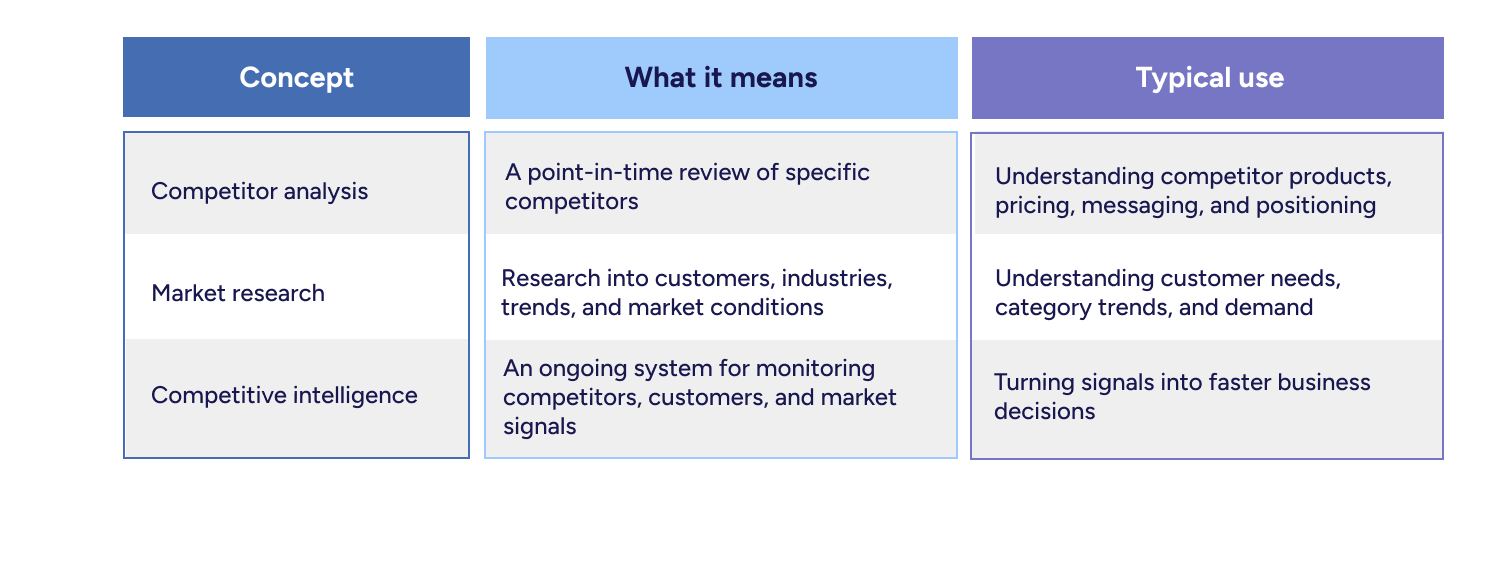
Competitive intelligence, competitor analysis, and market research are related, but they are not the same.
Competitor analysis gives you a snapshot. Market research gives you broader context. Competitive intelligence connects both into an ongoing decision-making system.
What signals should a competitive intelligence strategy track?
A CI strategy should monitor competitor messaging, product launches, pricing changes, customer sentiment, complaint patterns, social media conversations, news coverage, customer reviews, sales feedback, and CRM data.
Together, these signals create a more complete picture of where competitors are gaining ground, where they are losing trust, and where your brand has room to move.
Competitor messaging and campaign activity
Track changes in positioning, campaign themes, audience targeting, creative direction, and narrative shifts.
If competitors start emphasizing speed, trust, cost savings, sustainability, or personalization, that may signal a change in customer expectations or category pressure.
Product launches and pricing changes
Monitor new features, bundles, pricing pages, packaging updates, trials, discounts, and contract terms.
These signals help teams understand where competitors are investing and how they are reframing value.
Customer sentiment and complaint patterns
Customer complaints reveal where competitors are underdelivering.
Reviews, support complaints, social comments, and public frustration can expose unmet needs your team can address faster.
Social media conversations
Social conversations can reveal early audience reactions, untagged mentions, influencer activity, campaign response, and emerging customer expectations.
This is where social listening becomes an important input for competitive intelligence.
News and media coverage
Media coverage shows how competitors are being framed by journalists, analysts, industry publications, and public commentators.
This is the foundation of competitive benchmarking: comparing your brand’s coverage, tone, sentiment, and narrative position against competitors in real time.
Customer reviews and survey feedback
Customer reviews and surveys reveal recurring friction points, demand patterns, and service gaps.
When customers praise or criticize competitors repeatedly, they are giving your team a map of what the market values.
Internal sales and CRM signals
Sales teams often hear competitor objections before marketers see them in reports.
Win-loss notes, CRM data, sales calls, pipeline movement, and switching reasons help connect external market signals to revenue impact.
Strategic vs. tactical competitive intelligence
Strategic competitive intelligence informs long-term decisions such as positioning, product roadmap, market expansion, category strategy, and leadership planning.
It helps teams understand where the market is heading, which gaps are durable, and what moves will matter six or twelve months from now.
Tactical competitive intelligence supports short-term decisions such as campaign adjustments, pricing responses, messaging pivots, sales enablement, and competitor launch responses.
The strongest teams use both. Strategic CI sets direction. Tactical CI keeps execution responsive.
What top brands do differently: learning from success
Success leaves clues.
When a brand rises to the top, it is usually the result of deliberate moves, consistent messaging, disciplined execution, and deep customer understanding. The goal is not to envy their position. The goal is to understand what they saw, what they acted on, and what your team can learn.
Netflix: using market signals to guide content strategy
Netflix did not become a global streaming leader by relying only on broad global hits. Its growth strategy also included investment in local-language productions and international stories with global appeal.
Netflix ended 2023 with more than 260 million paid memberships, according to its Q4 2023 shareholder letter. Non-English titles such as Squid Game and Money Heist have also become some of Netflix’s most-watched shows globally, according to Netflix’s official Top 10 list.
The lesson for competitive intelligence is practical: repeated signals matter. When audience behavior, content gaps, and competitor blind spots point in the same direction, the opportunity is worth investigating.
What failure reveals: learning from competitor mistakes
Brands can also learn from what competitors fail to notice.
Failure often reveals ignored signals: rising complaints, declining sentiment, unmet expectations, weak product-market fit, poor timing, or slow crisis response.
The most valuable CI insight is often not what a competitor did. It is what they failed to do.
Quibi: what CI could have revealed
Quibi launched in April 2020 as a mobile-only short-form streaming platform with major funding and high-profile talent. But the service struggled to gain traction and announced it would wind down operations just six months later, according to Reuters. The Guardian also reported that Quibi was a $1.75 billion short-form content network that failed to meet subscriber goals.
What could competitive intelligence have revealed?
Audiences were gravitating toward flexible, shareable, user-driven short-form video experiences on platforms such as TikTok and YouTube. Quibi’s premium mobile-only format limited sharing and did not align with how users were already behaving.
The lesson is not that bold bets are bad. The lesson is that bold bets need strong market signal validation.
How to build a CI strategy your team will actually use
Turning competitive intelligence into action requires a defined sequence: analyze patterns, prioritize insights, distribute findings, assign ownership, translate insights into decisions, and measure outcomes.
The gap between gathering CI and acting on it is where most programs fail. The strongest teams treat CI as an operational input, not a periodic report.
Crayon’s 2024 State of Competitive Intelligence report found that 57% of CI leaders said their market had become much more competitive in recent years, compared with 51% in 2020.
1. Appoint a CI owner
Assign someone to own competitive intelligence: collecting, curating, synthesizing, and sharing insights consistently.
Cross-functional ownership works best when research, insights, marketing, sales, product, and customer experience teams are aligned.
2. Define what CI should answer
Start with clear business questions.
Are you trying to win more deals? Spot reputation risks earlier? Improve campaign timing? Understand why a competitor is gaining share? Detect unmet customer needs?
The sharper the question, the sharper the intelligence.
3. Build your CI stack
Choose tools that gather real-time data, benchmark trends, and surface insights without manual digging.
Your CI stack may include social listening, media monitoring, review tracking, CRM analysis, survey tools, competitive enablement platforms, and internal reporting dashboards.
4. Make CI a habit
Run regular intelligence reviews. Share quick CI wins in team meetings. Create a living dashboard that teams can reference.
A CI strategy only works when it becomes part of the operating rhythm.
5. Close the loop
Translate CI findings into action.
Test new messaging. Adjust campaign timing. Update sales battlecards. Prioritize product fixes. Create competitor response plans. Track whether these actions improve outcomes.
Useful CI performance metrics include share of voice movement, sentiment trend, competitive win rate, sales adoption, campaign performance, product roadmap influence, and stakeholder engagement.
For teams that need always-on monitoring, Lucidya Social Listening and Media Monitoring can help track competitive signals across public conversations and media coverage.
How CI connects to customer experience
Competitive intelligence helps CX teams detect when competitor service failures are driving customers to switch, identify rising expectations competitors are setting, and respond to sentiment shifts before they affect their own brand.
Real-time CI means CX teams are not reacting to problems after they escalate. They are anticipating them.
Customer signals do not live in one channel. When competitor moves, customer complaints, public sentiment, and audience expectations are connected to unified customer profiles, CX leaders can see which issues are spreading, which audiences are affected, and where service recovery can protect trust before reputation damage compounds.
How Lucidya powers competitive intelligence in real time
Lucidya helps teams turn competitive intelligence from scattered monitoring into real-time customer and market understanding.
Social Listening captures public conversations that reveal emerging demand, complaint patterns, influencer movement, competitor reactions, and shifting audience sentiment.
Media Monitoring tracks how brands and competitors are covered across news and industry sources, helping teams spot narrative shifts, risk signals, and competitive benchmarking opportunities.
Profiles connects customer and interaction signals to a clearer customer view, so marketing, CX, and leadership teams can understand how market changes affect real people, not just dashboards.
Real-time alerts help teams act on what is happening now instead of reviewing last week’s data after the window for action has passed.
Lucidya’s AI-powered CXM platform gives teams the intelligence they need to track competitors, spot trends, monitor sentiment, and make smarter marketing and CX decisions.
Your competitors are shaping how your customers think, choose, and expect.
A competitive intelligence strategy only matters when it becomes action.
Staying informed is no longer enough. In fast-moving markets, the brands that lead are those that detect shifts early, prioritize with clarity, and move before others react.
Competitive intelligence sharpens messaging, supports sales, informs product strategy, improves campaign timing, and aligns teams around what matters most.
The advantage does not come from knowing everything. It comes from knowing what matters early enough to act.
Frequently asked questions
What is a competitive intelligence strategy?
A competitive intelligence strategy is a structured plan for monitoring competitors, customers, and market signals, then turning those insights into decisions. It defines what to track, who owns the process, how insights are shared, and how success is measured.
How is competitive intelligence different from market research?
Market research is often project-based and may focus on broader customer or category questions. Competitive intelligence is continuous and focused on the signals that can influence current or near-term decisions across marketing, product, sales, and customer experience.
What are the main types of competitive intelligence?
The two main types are strategic CI and tactical CI. Strategic CI supports long-term decisions such as positioning, roadmap planning, and expansion. Tactical CI supports short-term moves such as campaign changes, pricing responses, and sales enablement.
What signals should a competitive intelligence strategy track?
A CI strategy should track competitor messaging, product launches, pricing changes, customer sentiment, social conversations, news coverage, reviews, surveys, sales feedback, and CRM signals.
How often should competitive intelligence be updated?
Monitoring should be continuous because customer sentiment, media coverage, and competitor activity can change quickly. Formal reviews and synthesis can happen weekly or monthly depending on how fast the market moves.
Is competitive intelligence legal and ethical?
Yes, when it uses public, permission-based, and compliant data sources. Competitive intelligence should never rely on deception, hacking, confidential information, or unethical data collection.
How do you measure whether a CI strategy is working?
Useful metrics include share of voice, sentiment trend movement, competitive win rate, sales adoption of CI outputs, campaign performance against competitors, and product or messaging decisions influenced by CI.
Lucidya is an AI-native customer experience management (CXM) platform that connects social listening, media monitoring, omnichannel customer service, a customer data platform, survey tools, and autonomous AI resolution into one system. The platform is built on proprietary NLP that processes Arabic natively across 17+ dialects with 92% sentiment accuracy, rather than relying on translation layers that lose nuance and context. Most enterprise CX teams run five or six separate tools to cover these functions, Lucidya replaces that stack with a single connected platform where every product shares the same data layer. The result: when your AI Agent resolves a customer case, it already knows that customer's sentiment history, social behavior, and full interaction record. When your PR team spots a brand mention in the news, that signal connects to the same platform handling customer service. Intelligence and action happen in one place.
What channels does Lucidya monitor?
Lucidya covers the full range of channels where customer conversations happen: social media (X, Instagram, Facebook, YouTube, TikTok, Snapchat), news and media (1,600+ online news sites, blogs, forums, print, TV, and radio), public reviews across 20+ platforms including Google Maps, Airbnb, TripAdvisor, Booking.com, Glassdoor, and G2, as well as WhatsApp, email, social DMs, live chat, voice and call center data, and survey and website feedback. Every channel feeds the same platform. So when something moves from social into news coverage, or from a WhatsApp complaint into a broader service pattern, your team sees it in one place rather than catching it late in a second tool.
What products make up the Lucidya platform?
Lucidya is six integrated products on one AI engine, deployable together or individually. Social Listening monitors brand mentions, competitor activity, and emerging trends across social channels in real time. Media Monitoring tracks brand presence across 1,600+ news, blog, forum, print, TV, and radio sources — the coverage that social-only tools miss. OmniServe is an omnichannel inbox that unifies messages from social media, WhatsApp, email, and live chat into one AI-powered workspace with sentiment-aware routing and full customer context for every agent. Profiles is a Customer Data Platform that builds 360-degree customer views by connecting behavioral, sentiment, interaction, and demographic data across all touchpoints. It combines customer identities and interactions from multiple channels into one centralized profile, so teams can see the full history of how a customer has engaged across social, support, surveys, and every other channel in one place. Survey collects and analyzes customer feedback across channels with AI-native sentiment analysis on open-text responses. AI Agent resolves customer cases end to end autonomously across WhatsApp, social media, and other channels, executing actions, completing workflows, and closing cases without human intervention. Role-based access controls, PII masking, audit trails, and a kill switch are built in for regulated industries.
How does Lucidya differ from other enterprise CX platforms?
Most enterprise CX platforms are built around one primary function, ticketing, social listening, or marketing, and require additional tools for everything else. Lucidya is built as a unified system from the ground up. Unified data layer. Every product shares the same underlying data. The AI Agent has access to social listening data. The omnichannel inbox connects to the CDP. Media monitoring feeds the same dashboard as social. This eliminates the data silos that make enterprise CX slow and reactive. Proactive by design. Lucidya's intelligence layer monitors brand mentions, tracks sentiment shifts, and surfaces competitor activity before customers contact you. Most platforms start at the ticket. Lucidya starts earlier. Modular adoption. Unlike platforms that require full migration to access AI capabilities, Lucidya's products can be adopted individually. Start with social listening, add the AI Agent later, without rebuilding your stack. Multilingual accuracy. Lucidya's AI engine achieves 92% sentiment accuracy in both English and Arabic, with native training across 17 Arabic dialects. For global brands operating in Arabic-speaking markets, this is the difference between accurate intelligence and confident noise.
What types of organizations use Lucidya?
Lucidya serves enterprise brands, government entities, and large organizations that need accurate, real-time customer intelligence at scale. Key sectors include banking and financial services, telecommunications, travel and tourism, insurance, hospitality, healthcare, and logistics. It is used by organizations that need proactive brand intelligence, not just reactive ticketing, and by regulated industries that require compliance-grade governance controls over their AI systems. For global enterprises operating in or expanding into Arabic-speaking markets, Lucidya provides the only CXM platform with native Arabic-language AI across 17 dialects.
How does Lucidya handle data privacy and compliance?
Lucidya complies with GDPR, CCPA/CPRA, Saudi PDPL, SOC 2 Type II, ISO/IEC 27001, ISO 27017, HIPAA Ready, NIST CSF, and Tier 2 CASA Verified standards, with regional data hosting available in Saudi Arabia and the GCC. This covers the core compliance requirements for enterprise deployments in the UK, US, EU, and Gulf markets. For organizations operating in Saudi Arabia and the GCC, Lucidya additionally holds SDAIA and NCA ECC/CCC certifications with regional data hosting options. All AI Agent actions are governed by a policy engine, logged in a full audit trail, and can be paused instantly. Role-based access controls and PII masking are built into the core platform.
How accurate is Lucidya's sentiment analysis?
Lucidya achieves 92% sentiment accuracy in both English and Arabic. For English-language markets, this means reliable sentiment detection across social, news, and customer service interactions without the false positives that degrade signal quality at scale. For Arabic-language markets, accuracy at this level requires native training rather than translation. Lucidya's NLP engine is trained on 17 Arabic dialects, covering Gulf Arabic (Khaleeji Arabic), Egyptian, Levantine, Maghrebi, and other regional variants, because sentiment in Arabic varies significantly across dialects. Tools that translate Arabic to English before analysis lose this nuance before any processing occurs. For global brands with operations in MENA, this is the accuracy gap that makes or breaks customer intelligence in the region.
What makes Lucidya a strong choice for global brands?
Global brands face a specific version of the fragmented CX problem, they need tools that work across markets, languages, and regulatory environments without requiring a different vendor for each region. Lucidya addresses this in three ways. One platform across channels. Social, news, messaging, live chat, surveys, and AI resolution in one system, regardless of which market you're operating in. Compliance built in. GDPR, CCPA, SOC 2, ISO 27001, and regional certifications for Gulf markets, covered in one platform rather than requiring separate compliance configurations per region. Multilingual AI that actually works. 92% sentiment accuracy in English and Arabic, with native dialect training rather than translation. For brands expanding into the Middle East, or already operating there, this is the capability that global-first platforms cannot replicate from a standing start.
Take the next step toward a smarter customer experience
Dive deeper with fresh perspectives for smarter CX

.svg)






.svg)




.svg)