Media monitoring for brand reputation: How to detect risk and control your narrative
Learn how media monitoring helps brands detect reputation risks early, track narrative shifts, and respond before small signals become public crises.
July 30, 2025
|
12
min read
|
Author:
Nour Manasseh
Media monitoring for brand reputation is the practice of tracking how a brand is covered, mentioned, and discussed across news outlets, social media, blogs, forums, reviews, broadcast channels, and digital publications.
The goal is not only to count mentions. It is to understand public perception, detect reputation risks early, and respond before negative narratives take hold.
Media monitoring protects brand reputation by giving teams early warning when sentiment shifts, when a negative story gains traction, or when a competitor narrative fills a gap left by the brand. The earlier a team detects a risk, the more options it has to respond, correct, or contain it.
Key takeaways
Media monitoring needs strategic intent: Reputation monitoring should focus on perception gaps, narrative shifts, and risk detection, not just mention volume.
Mentions are not enough: The real question is how your brand is being framed, repeated, and interpreted across channels.
Narratives operate on multiple layers: Brands need to track authored, mediated, emergent, and residual narratives to understand reputation risk fully.
Red flags appear before crises: Message mutation, echo chamber escalation, influencer backchanneling, and legacy resurgence can all signal early risk.
Action matters: Monitoring only protects reputation when insights are connected to a response workflow.
Why media monitoring falls short of reputation intelligence
Tracking media mentions tells you where your brand appeared and whether the coverage looks positive, negative, or neutral. Protecting your brand narrative requires understanding how your message is being retold, by whom, in what context, and whether the meaning is drifting away from your strategic intent.
The first is a reporting function. The second is a strategic one.
Many monitoring setups are calibrated for the first and miss the second.
If you search for media monitoring platforms and read the reviews, you will likely find that the answers almost always come with a “but.”
“The coverage is decent, but it misses important sources.”
“The interface works well, but the sentiment analysis is unreliable.”
“It catches most mentions, but you spend hours filtering noise.”
Brand and communications teams have often accepted these limitations as inevitable. Mentions go undetected. Sentiment data needs manual checking. Dashboards capture exposure but do not always explain whether the brand story is being strengthened, distorted, or weakened.
That is the gap between monitoring and reputation intelligence.
Monitoring only becomes meaningful when it is tied to strategic goals such as protecting reputation, identifying perception gaps, informing messaging, benchmarking competitors, or evaluating campaign impact.
A dashboard can show what happened. A strong media intelligence system helps teams decide what to do next.
Media monitoring vs. social listening
Media monitoring and social listening are related, but they are not identical.
Social listening focuses on audience conversations across social platforms. It helps teams understand sentiment, trends, campaign reactions, creator activity, and community-level discussion.
Media monitoring covers a broader mix of sources, including news outlets, blogs, online publications, reviews, forums, and other digital coverage.
Reputation intelligence connects both. It brings social signals and media signals together so teams can understand not only where the brand is mentioned, but how public perception is forming across the wider information ecosystem.
What brands should monitor to protect reputation
A media monitoring strategy should cover the signals that shape how people understand your brand, not just the terms that generate the most alerts.
Teams should monitor:
Brand names and common misspellings
Executive and spokesperson names
Product, service, and campaign keywords
Competitor coverage and share of voice
Relevant hashtags, forums, reviews, and community conversations
Industry terms connected to reputation risk
News coverage and digital publication mentions
Sentiment score, mention volume, message pull-through, media reach, and sentiment volatility
The goal is to connect these signals to a decision-making workflow. A spike in mentions may be harmless. A smaller shift in framing may be more serious. Reputation monitoring should help teams understand the difference.
The narrative influence quadrant
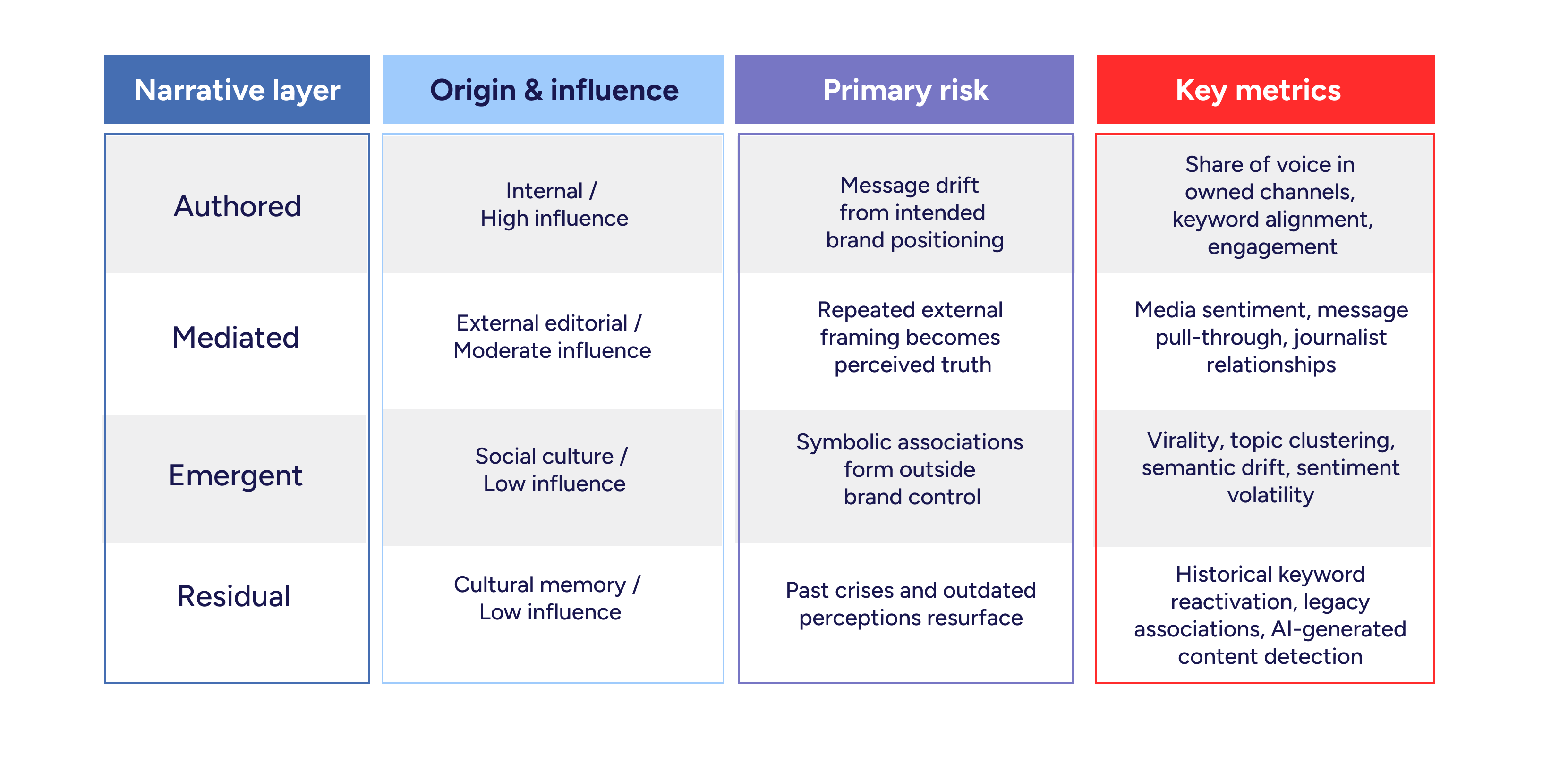
Most monitoring tools treat all mentions the same way, but your brand story usually operates on different levels.
The Narrative Influence Quadrant maps where your brand has high control and where it needs stronger visibility. It helps teams focus on the narrative shifts that directly affect reputation and strategic positioning.
This framework is inspired by brand control thinking in the search and AI visibility space, including Semrush’s work on the Brand Control Quadrant, but adapted here for media monitoring and reputation intelligence.
The authored narrative
The authored narrative includes the stories a company tells about itself: its mission, positioning, campaigns, executive interviews, website copy, social content, and investor communication.
This is where the brand has the highest level of control.
Useful metrics include:
Owned content engagement
Share of voice in owned channels
Keyword alignment between brand messaging and media coverage
Brand asset reuse across coverage
Message consistency across official channels
The mediated narrative
The mediated narrative is how third-party sources interpret and reshape your message.
These stories live in journalism, analyst commentary, creator content, industry newsletters, and other external coverage.
Useful metrics include:
Media sentiment by outlet type
Message pull-through
Outlet credibility and reach
Journalist and creator relationships
Coverage framing patterns
The question is not only whether your brand appeared. The question is how your story was retold and who shaped that interpretation.
The emergent narrative
The emergent narrative is where brand meaning becomes shaped by wider public conversation.
Your brand may start appearing as a comparison point, a meme, a shorthand for a category, or a symbol of something outside your original positioning.
Useful metrics include:
Mention velocity
Hashtag co-occurrence
Topic clustering
Creator and community amplification
Sentiment volatility
Semantic drift
This layer is especially important because it can reshape perception faster than official messaging can correct it.
The residual narrative
The residual narrative represents your brand’s memory in public culture.
Past crises, outdated associations, previous positioning, old complaints, or earlier controversies can resurface during new conversations, even when the current issue is unrelated.
Useful metrics include:
Historical keyword reactivation
Recurring themes in older coverage
Association with past events
Persistence of outdated perceptions
Sentiment resilience over time
These are the reputation signals that often remain invisible until a new event brings them back.
4 reputation red flags your monitoring setup is probably missing
The biggest warning signs that media monitoring is failing are message mutation, echo chamber escalation, influencer backchanneling, and legacy resurgence.
Each one signals that your monitoring setup may be capturing volume while missing the narrative shifts that actually damage reputation.
Red flag 1: Message mutation
Message mutation happens when your original brand language changes as it moves through media, commentary, and public conversation.
It is not always a dramatic misquote. Sometimes it is gradual erosion of meaning.
What to monitor:
Word swapping patterns: Track when key terms are replaced with words that carry different emotional weight. “Premium” can become “expensive.” “Accessible” can become “cheap.” “Innovation” can become “disruption.”
Contextual reframing: Monitor how your statements appear in different outlets. A message about expansion may be framed as market leadership in one outlet and aggressive growth in another.
Message pull-through: Check whether your intended themes survive the editorial filter or disappear once the story moves beyond owned channels.
Red flag 2: Echo chamber escalation
Echo chamber escalation happens when one negative story is repeated across multiple outlets, creating the appearance of broad consensus.
This can become dangerous because a dashboard may register it as increased coverage volume when it is actually repeated framing that needs investigation.
What to monitor:
Copy-paste patterns: Watch for identical or lightly rewritten text across multiple publications.
Clustered sentiment shifts: Track whether sentiment changes sharply across several sources at the same time.
Repeated framing: Monitor whether the same negative phrase, comparison, or angle appears across unrelated coverage.
The risk is not only that a negative story exists. The risk is that repetition turns it into perceived truth.
Red flag 3: Influencer backchanneling
Influencer backchanneling happens when creators, commentators, or community voices redefine your brand meaning outside your official communications.
This becomes a reputation risk when your brand becomes symbolic shorthand for something you did not intend.
What to monitor:
Analogical usage: Track when people use your brand as a comparison point in conversations unrelated to your business.
Memetic use: Monitor how brand names, slogans, logos, or phrases appear in memes, reaction content, and viral formats.
Cross-platform amplification: Watch whether commentary from one platform is picked up by media outlets, newsletters, or other creator communities.
Once a brand becomes shorthand for a negative idea, traditional campaign messaging may not be enough to correct it.
Red flag 4: Legacy resurgence
Legacy resurgence happens when old perceptions, previous crises, or outdated associations reappear in current coverage.
This can immediately change how audiences interpret new announcements, campaigns, or leadership messages.
What to monitor:
Historical keyword reactivation: Track when old crisis terms, complaints, or outdated language start appearing in current conversations.
Comparative journalism patterns: Monitor when your brand is used as a historical reference point in coverage about competitors, industry issues, or public debates.
Recurring reputation themes: Watch whether the same old concern keeps returning even when the news cycle changes.
Legacy narratives do not disappear just because the brand has moved on. They need to be monitored and managed.
What to do when a red flag appears
When media monitoring reveals narrative risk, teams need a clear response workflow.
Use five steps:
1. Detect the signal
Identify the signal through sentiment shifts, message mutation, clustered coverage, unusual share-of-voice changes, or repeated framing.
2. Validate the pattern
Confirm whether the pattern appears across multiple independent sources or is limited to one isolated mention.
Not every negative post is a crisis. But repeated framing across credible sources deserves attention.
3. Identify the source
Trace where the narrative started and who is amplifying it.
A risk that begins with a small community may need a different response from one amplified by a major outlet or high-reach commentator.
4. Align the response
Bring PR, communications, leadership, legal, customer experience, and relevant internal teams around one message before responding publicly.
Conflicting responses can create more confusion than silence.
5. Track recovery
Monitor sentiment, framing, reach, and message pull-through over the following days.
The work is not done when a response goes live. It is done when the narrative stabilizes or shifts in the right direction.
What PR and communications teams should look for in a media monitoring platform
A strong media monitoring platform should help teams detect risks early, understand context, and turn coverage into decisions.
Look for:
Real-time alerts for mention spikes and sentiment shifts
Broad source coverage across news, blogs, reviews, forums, and digital publications
Sentiment analysis and tone tracking
Topic clustering and narrative pattern detection
Competitor and industry benchmarking
Executive-ready reporting
Share of voice and message pull-through analysis
Workflow support for escalation and response
The best platform is not the one that produces the most mentions. It is the one that helps your team understand which signals matter and what to do next.
How Lucidya approaches narrative intelligence
Media monitoring becomes more valuable when it moves beyond mention tracking and becomes a source of reputation intelligence.
Lucidya Media Monitoring helps teams track news, blogs, and publications in real time, with alerts that surface risks before they become harder to contain.
Social Listening expands visibility into public conversations, helping teams understand audience sentiment, campaign reactions, and emerging community signals.
Profiles helps connect customer and interaction signals into a fuller view of how reputation, sentiment, and customer experience intersect.
Together, these tools help communications, PR, marketing, and CX teams move from reactive reporting to proactive reputation intelligence.
When leadership asks difficult questions, teams should not be limited to damage reports. They should be able to explain what changed, where it started, who amplified it, and what action is needed next.
Media monitoring for brand reputation is the practice of tracking how a brand is covered and discussed across news, blogs, social platforms, forums, reviews, broadcast, and digital publications. It helps teams understand perception, detect reputation risks, and respond before negative narratives escalate.
How is media monitoring different from social listening?
Media monitoring tracks coverage across news, blogs, forums, reviews, broadcast, and digital publications. Social listening focuses on conversations across social platforms. Reputation intelligence combines both to understand how public perception is forming across channels.
What are the most important metrics for brand reputation monitoring?
Important metrics include sentiment score, mention volume, share of voice, message pull-through, sentiment volatility, media reach, outlet credibility, topic clustering, and recovery time after response.
What are the biggest warning signs that media monitoring is failing?
The biggest warning signs are message mutation, echo chamber escalation, influencer backchanneling, and legacy resurgence. These signals suggest your team may be tracking volume but missing shifts in meaning, framing, and perception.
Can media monitoring detect a crisis before it escalates?
Yes, when it is configured to track narrative signals rather than mention volume alone. Red flags such as repeated negative framing, sentiment volatility, clustered coverage, and legacy keyword reactivation can appear before an issue becomes a larger public crisis.
What is the difference between media monitoring and reputation intelligence?
Media monitoring tracks where and how a brand is mentioned across media channels. Reputation intelligence goes further by analyzing sentiment, framing, narrative shifts, source credibility, and risk patterns so teams can decide what action to take.
Lucidya is an AI-native customer experience management (CXM) platform that connects social listening, media monitoring, omnichannel customer service, a customer data platform, survey tools, and autonomous AI resolution into one system. The platform is built on proprietary NLP that processes Arabic natively across 17+ dialects with 92% sentiment accuracy, rather than relying on translation layers that lose nuance and context. Most enterprise CX teams run five or six separate tools to cover these functions, Lucidya replaces that stack with a single connected platform where every product shares the same data layer. The result: when your AI Agent resolves a customer case, it already knows that customer's sentiment history, social behavior, and full interaction record. When your PR team spots a brand mention in the news, that signal connects to the same platform handling customer service. Intelligence and action happen in one place.
What channels does Lucidya monitor?
Lucidya covers the full range of channels where customer conversations happen: social media (X, Instagram, Facebook, YouTube, TikTok, Snapchat), news and media (1,600+ online news sites, blogs, forums, print, TV, and radio), public reviews across 20+ platforms including Google Maps, Airbnb, TripAdvisor, Booking.com, Glassdoor, and G2, as well as WhatsApp, email, social DMs, live chat, voice and call center data, and survey and website feedback. Every channel feeds the same platform. So when something moves from social into news coverage, or from a WhatsApp complaint into a broader service pattern, your team sees it in one place rather than catching it late in a second tool.
What products make up the Lucidya platform?
Lucidya is six integrated products on one AI engine, deployable together or individually. Social Listening monitors brand mentions, competitor activity, and emerging trends across social channels in real time. Media Monitoring tracks brand presence across 1,600+ news, blog, forum, print, TV, and radio sources — the coverage that social-only tools miss. OmniServe is an omnichannel inbox that unifies messages from social media, WhatsApp, email, and live chat into one AI-powered workspace with sentiment-aware routing and full customer context for every agent. Profiles is a Customer Data Platform that builds 360-degree customer views by connecting behavioral, sentiment, interaction, and demographic data across all touchpoints. It combines customer identities and interactions from multiple channels into one centralized profile, so teams can see the full history of how a customer has engaged across social, support, surveys, and every other channel in one place. Survey collects and analyzes customer feedback across channels with AI-native sentiment analysis on open-text responses. AI Agent resolves customer cases end to end autonomously across WhatsApp, social media, and other channels, executing actions, completing workflows, and closing cases without human intervention. Role-based access controls, PII masking, audit trails, and a kill switch are built in for regulated industries.
How does Lucidya differ from other enterprise CX platforms?
Most enterprise CX platforms are built around one primary function, ticketing, social listening, or marketing, and require additional tools for everything else. Lucidya is built as a unified system from the ground up. Unified data layer. Every product shares the same underlying data. The AI Agent has access to social listening data. The omnichannel inbox connects to the CDP. Media monitoring feeds the same dashboard as social. This eliminates the data silos that make enterprise CX slow and reactive. Proactive by design. Lucidya's intelligence layer monitors brand mentions, tracks sentiment shifts, and surfaces competitor activity before customers contact you. Most platforms start at the ticket. Lucidya starts earlier. Modular adoption. Unlike platforms that require full migration to access AI capabilities, Lucidya's products can be adopted individually. Start with social listening, add the AI Agent later, without rebuilding your stack. Multilingual accuracy. Lucidya's AI engine achieves 92% sentiment accuracy in both English and Arabic, with native training across 17 Arabic dialects. For global brands operating in Arabic-speaking markets, this is the difference between accurate intelligence and confident noise.
What types of organizations use Lucidya?
Lucidya serves enterprise brands, government entities, and large organizations that need accurate, real-time customer intelligence at scale. Key sectors include banking and financial services, telecommunications, travel and tourism, insurance, hospitality, healthcare, and logistics. It is used by organizations that need proactive brand intelligence, not just reactive ticketing, and by regulated industries that require compliance-grade governance controls over their AI systems. For global enterprises operating in or expanding into Arabic-speaking markets, Lucidya provides the only CXM platform with native Arabic-language AI across 17 dialects.
How does Lucidya handle data privacy and compliance?
Lucidya complies with GDPR, CCPA/CPRA, Saudi PDPL, SOC 2 Type II, ISO/IEC 27001, ISO 27017, HIPAA Ready, NIST CSF, and Tier 2 CASA Verified standards, with regional data hosting available in Saudi Arabia and the GCC. This covers the core compliance requirements for enterprise deployments in the UK, US, EU, and Gulf markets. For organizations operating in Saudi Arabia and the GCC, Lucidya additionally holds SDAIA and NCA ECC/CCC certifications with regional data hosting options. All AI Agent actions are governed by a policy engine, logged in a full audit trail, and can be paused instantly. Role-based access controls and PII masking are built into the core platform.
How accurate is Lucidya's sentiment analysis?
Lucidya achieves 92% sentiment accuracy in both English and Arabic. For English-language markets, this means reliable sentiment detection across social, news, and customer service interactions without the false positives that degrade signal quality at scale. For Arabic-language markets, accuracy at this level requires native training rather than translation. Lucidya's NLP engine is trained on 17 Arabic dialects, covering Gulf Arabic (Khaleeji Arabic), Egyptian, Levantine, Maghrebi, and other regional variants, because sentiment in Arabic varies significantly across dialects. Tools that translate Arabic to English before analysis lose this nuance before any processing occurs. For global brands with operations in MENA, this is the accuracy gap that makes or breaks customer intelligence in the region.
What makes Lucidya a strong choice for global brands?
Global brands face a specific version of the fragmented CX problem, they need tools that work across markets, languages, and regulatory environments without requiring a different vendor for each region. Lucidya addresses this in three ways. One platform across channels. Social, news, messaging, live chat, surveys, and AI resolution in one system, regardless of which market you're operating in. Compliance built in. GDPR, CCPA, SOC 2, ISO 27001, and regional certifications for Gulf markets, covered in one platform rather than requiring separate compliance configurations per region. Multilingual AI that actually works. 92% sentiment accuracy in English and Arabic, with native dialect training rather than translation. For brands expanding into the Middle East, or already operating there, this is the capability that global-first platforms cannot replicate from a standing start.
Take the next step toward a smarter customer experience
Dive deeper with fresh perspectives for smarter CX

.svg)






.svg)




.svg)